
Care & Repair
Most shrinkage happens in the dryer and heat is only half the reason
Garments contract for three quite different reasons, and only one of them is permanent, which is why some shrunken clothes can be coaxed back and others never will be.
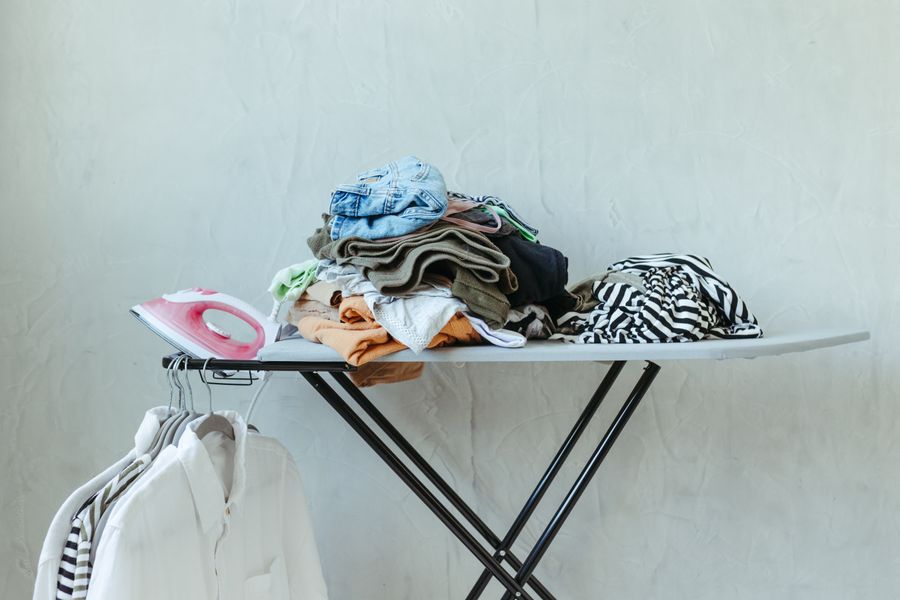
Three different things called shrinking
When a garment comes out smaller than it went in, at least three separate mechanisms could be responsible, and they have different consequences. Lumping them together as shrinkage is why the advice on the subject is so contradictory.
The first is relaxation shrinkage. Yarn is under tension throughout spinning, weaving or knitting, and finishing processes stretch the cloth further to make it flat and wide. Wet the fabric and the fibres swell, the yarns are freed to contract towards their natural length, and the whole cloth pulls in. This is why so much shrinkage happens in the very first wash.
The second is felting, which affects wool and other scaled animal fibres. Heat, moisture and agitation together let the scales ratchet past one another until the fibres are irreversibly entangled. That is a structural change to the fabric and no treatment brings it back.
The third is thermal. Synthetic fibres are heat-set during manufacture, and exposing them to temperatures approaching that setting point lets them relax and contract. This is a dryer problem far more than a washing problem, because a dryer routinely gets hotter than wash water does.
Why the dryer does the most damage
A tumble dryer supplies all the conditions the mechanisms need. It is hot, the load is damp for much of the cycle, and it is being tumbled constantly. For wool that is precisely the recipe for felting; for synthetics it is enough heat to let heat-set fibres relax; for cotton it drives relaxation shrinkage further than air drying would.
This is why a wool garment can survive a careful cool hand wash and be destroyed in twenty minutes of tumbling, and why people conclude the washing was fine when it was the drying that did it.
It also explains the odd observation that a garment seems to shrink a little more each time and then partly recover as it is worn. Cotton in particular contracts in the dryer and is stretched back out by the body, which is a cycle rather than a single event.
Stretching is mistaken for shrinking too
A good deal of what people call shrinkage is the garment returning to its correct size after having been stretched. A cotton jersey T-shirt pulled out of shape across the shoulders by a hanger, or a knit that has grown at the cuffs during a day of wear, will come back smaller after washing — and it looks like shrinkage while actually being recovery.
The opposite mistake is common with heavy knitwear. Hang a wet wool jumper on a hanger and gravity will pull it long and narrow, permanently, because the wet fibres are pliable and the whole weight of the water-laden garment is carried by the loops at the shoulder.
Which is why the standard instruction for knitwear is to dry flat, ideally on a towel, gently pushed back into its proper shape while damp. It is not fussiness. It is the only moment at which the shape can still be set.
What can be undone and what cannot
Relaxation shrinkage is partly reversible. Wet the garment, lay it flat, and stretch it gently and evenly back towards its size while damp, then let it dry in that position. It is imperfect and it works better on knits than on wovens, but it is a real technique and it costs nothing to try.
Felting is not reversible. Various remedies circulate for it — soaking in a hair conditioner or a wool wash to lubricate the fibres, then blocking the garment out — and they can gain a little by relaxing the fabric slightly. They do not disentangle the fibres, because nothing does. Expect an improvement of a small margin, not a rescue.
Thermal shrinkage in synthetics is likewise permanent, since the fibres have physically relaxed to a shorter length. There is no process that puts the length back.
Avoiding the problem in the first place
Pre-shrunk and sanforized labels tell you the maker has already put the cloth through a controlled shrinking process, so most of the relaxation shrinkage has been used up before you bought it. Residual shrinkage still exists and it is normal for a small further contraction to occur, particularly on the first hot wash.
For wool, break the triangle. Remove heat, or moisture, or agitation, and felting cannot proceed. Cool water and a still soak with minimal handling removes two of the three. Never wash wool in a machine unless it is treated for it and the machine has a genuine wool programme, which is a slow-drum cycle rather than a low-temperature one.
And read the care label as information about what the manufacturer tested, not as a legal restriction. It is a conservative statement of what they are confident will not ruin the garment. Departing from it is sometimes reasonable, but the risk becomes yours, and on anything expensive or irreplaceable that is a poor bet.
Common questions
Can I deliberately shrink a garment to fit?
Sometimes, with cotton, and unpredictably. A hot wash and a hot dry will contract cotton, but not evenly and not in a direction you control, so a shirt frequently ends up shorter in the body without becoming narrower where you wanted it. An alteration is more reliable and less destructive.
Why does the same garment shrink again after several washes?
Because relaxation shrinkage is progressive rather than a single event, and because the garment is being stretched back out by wear between washes. Each cycle recovers some of what wearing stretched. If a garment shrinks substantially every time, it is more likely felting or repeated hot drying.
Is air drying always better?
For fabric life, generally yes: no heat, no tumbling, less abrasion. The exceptions are practical rather than technical. Drying heavy garments indoors in a damp climate can take long enough to smell musty, and some fabrics dry stiff without the movement a dryer provides. A short cool tumble at the end of air drying is a reasonable compromise.
Nikhil has written about fit, fabric, care & repair for most of the last decade and is happiest when a piece answers the question completely.