
Fit
A high armhole looks uncomfortable and is the opposite
The small, tight-looking armhole in a well-cut jacket is what lets you raise your arm without lifting the entire garment, and the roomy one does the reverse.
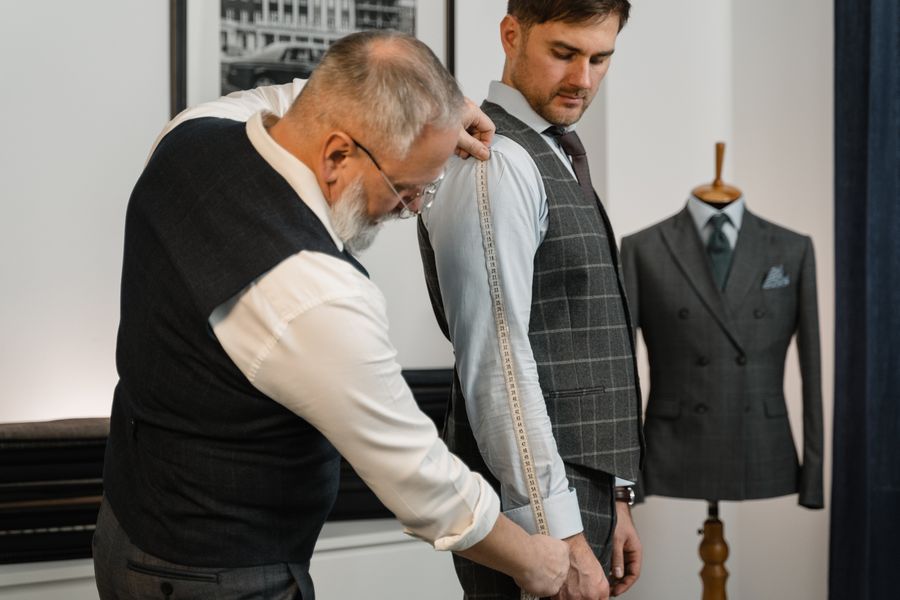
The counterintuitive part
Hold up a well-cut jacket and the armhole looks small. Uncomfortably small, if your instinct is that more room means more comfort. Put it on and raise your arm, and the sleeve moves while the body of the jacket stays exactly where it was. Now do the same in a jacket with a big, low, generous armhole and the entire garment climbs — chest, back, collar and all.
That is the whole argument, and it takes about two seconds to demonstrate in a fitting room. The armhole is the joint between a part of the garment that must move and a part that must not, and the smaller and higher that joint sits, the less of the body it drags along with the arm.
The reasoning is geometric rather than mysterious. When you lift your arm, the sleeve pivots around the armhole. If the bottom of the armhole is up in your armpit, the pivot point is close to the actual joint in your shoulder and there is very little cloth below it to be pulled. If the bottom of the armhole is halfway down your ribs, everything between the armpit and that point has to travel upward with the sleeve.
Why cheap clothing goes the other way
A high armhole has to be cut accurately. It follows the curve of the body closely, which means it has to know the shape of that curve, and it leaves very little margin for a body that differs from the pattern. Cut a high armhole a centimetre wrong and it chafes.
A low armhole is forgiving of everything. It fits a wider range of chests, it needs less easing when the sleeve is set in, and it is faster to sew because there is less curvature to control. For a manufacturer covering many body types with one pattern, dropping the armhole is the cheapest way to reduce complaints — and the customer who tries it on standing still, arms down, in front of a mirror will never notice the cost.
You pay it later. The jacket that felt roomy on the hanger is the one that rides up when you reach for a door handle, hitches at the collar when you drive, and needs tugging back down every few minutes.
Sleeve head ease is the other half of the mechanism
An armhole on its own does not make a sleeve move well. The top of the sleeve — the sleeve head — is cut with more length than the armhole opening, and that extra is eased in with fine gathers distributed around the curve, mostly across the top and front. The surplus becomes a slight roll of cloth that gives the sleeve somewhere to go when the arm rotates.
Doing this properly is skilled work. Too much ease and the sleeve head puckers visibly; too little and the sleeve is pulled flat against the armhole and binds. Fused, heavily pressed construction can flatten out ease that was in the pattern to begin with, which is one reason two jackets with identical measurements can move so differently.
None of this shows in a photograph and none of it appears on a label. It is the part of tailoring you can only assess by putting the garment on and moving in it, which is a good argument for doing exactly that before buying anything with a set-in sleeve.
Casual garments are playing a different game
It would be wrong to conclude that low armholes are simply a defect. A raglan sleeve, where the seam runs from the underarm to the neck instead of circling the shoulder, has no conventional armhole at all and moves superbly — which is why it turns up on coats designed to be worn over other clothing and on garments meant for hard use.
Drop-shoulder knitwear and boxy overshirts deliberately place the seam down the arm, and in those the low armhole is part of the design rather than a compromise. They accept a looser relationship between garment and body in exchange for room, layering capacity and a particular silhouette. That is a legitimate trade and it is not the same as a tailored jacket cut carelessly.
The distinction to hold onto is intent. A garment designed around a low armhole has the rest of its pattern drawn to suit. A tailored jacket with a dropped armhole is a tailored jacket that has quietly given something up.
What you can and cannot do afterwards
Raising an armhole is a serious alteration, because the armhole is bounded by the side seam, the shoulder seam and the sleeve, and shortening it means recutting the opening and reworking the sleeve to fit the new curve. A tailor can sometimes lift it a small amount when taking a jacket in at the sides, since the two operations meet at the same seam. Beyond that, you are rebuilding.
Lowering an armhole is easier and occasionally necessary when a garment binds, but it is a one-way door — cloth removed from the underarm is not coming back, and the jacket will move less well ever after.
So this joins the shoulder and the rise on the short list of things to settle before money changes hands. Put the jacket on, do up the button, and reach forward as though picking something off a shelf. If the collar leaves your neck and the whole jacket rises, the armhole is telling you something that no alteration ticket will fix.
Common questions
Should a high armhole feel tight in the armpit?
It should feel close, not tight. You want the seam sitting near the top of the armpit without cutting into it or catching when you lower your arm. If there is genuine pressure or chafing on the underarm seam, the armhole is too high or too narrow for you, which is a real fault rather than a virtue.
Do shirts have the same issue?
Yes, though with less at stake, because a shirt is soft and lightweight and can be dragged out of place without looking ruined. It is still noticeable: a shirt with a very low armhole pulls at the collar when you raise your arms, and one cut closer stays put. Dress shirts generally sit higher than casual ones.
Is a raglan sleeve better than a set-in sleeve?
Better for movement and for layering, and less good at holding a defined shoulder line, because there is no seam sitting on the shoulder to create one. Coats and outerwear often use raglan for that reason while suit jackets almost never do. They are answers to different questions rather than one being an improvement on the other.
Lukas joined to cover fit, fabric, care & repair and stayed for the awkward questions and reads the small print so you do not have to.