
Fabric
Wool works because the fibre is crimped and covered in scales
Nearly everything wool does well, and the two things it does badly, come from the physical architecture of a single hair rather than from its chemistry.
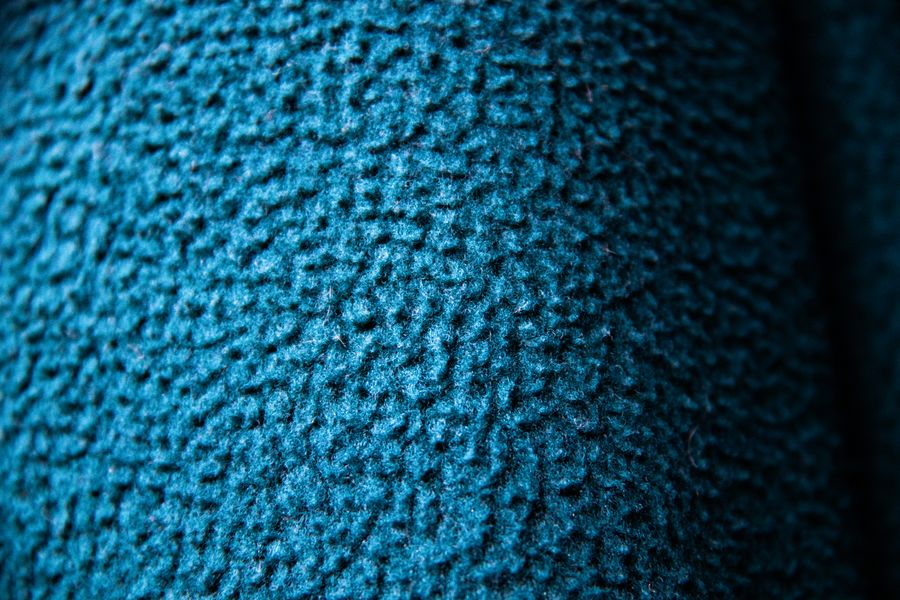
A fibre with architecture
Most textile fibres are, at the scale that matters, fairly simple objects: a filament of roughly uniform material. A wool fibre is not. It has an outer layer of overlapping scales pointing towards the tip, an inner cortex built from two kinds of cell with slightly different properties, and a natural wave along its length.
That structure was not designed for clothing, obviously. It evolved to keep a sheep alive in weather. But it happens to solve several problems that clothing has, and it does so through mechanics rather than through any special chemistry.
The wave is called crimp, and finer wool has more of it. It is the reason a heap of raw wool takes up so much more space than the same weight of cotton, and that fact alone accounts for most of what wool is valued for.
Crimp is the insulation
Fibres with a permanent wave cannot lie flat against one another. They hold each other apart, and the space between them fills with air. Still air is a poor conductor of heat, so a wool garment is mostly a way of keeping a layer of motionless air next to the body — the wool itself is doing rather less of the insulating than people assume.
This explains why loft matters more than weight for warmth, and why compressing a woollen garment reduces its warmth immediately. Sit on a wool coat and the part you sat on is temporarily thinner and colder until the crimp pushes the fibres apart again.
Crimp also produces resilience. A crimped fibre bent out of shape stores energy like a small spring and returns towards its original form, which is why creases fall out of wool overnight and why a wool jumper regains its shape after being pulled over your head. Cotton, which has no such spring, keeps the crease.
The scales explain the itch and the felting
The overlapping scales on the surface are the source of two of wool's best-known properties. The first is prickle. A coarse fibre is stiff enough that when its cut end is pressed against skin it does not bend, and it registers as a scratch. Fineness, measured as fibre diameter, is what determines this, which is why the softness of a wool has more to do with the diameter of its fibres than with the name of the breed.
The second is felting. Because the scales all point one way, a fibre agitated in warm water can move in one direction more easily than the other, so fibres ratchet past one another and progressively tangle. The mass shrinks and locks together, and it does not come back. This is what has happened to a jumper that went through a hot wash and emerged doll-sized.
Felting is not a defect; it is the basis of an entire family of fabrics, and felt was in use long before spinning and weaving. What makes it a problem is only that it happens to garments that were not supposed to felt.
Moisture is where wool separates from everything else
Wool takes up a great deal of water vapour into the body of the fibre — a substantially larger share of its own dry weight than cotton manages, and vastly more than any common synthetic — while the outer surface stays relatively water-repellent. The practical result is that wool feels dry when it is carrying a lot of moisture.
There is a second, less familiar effect. When a fibre absorbs water vapour it releases a small amount of heat, so wool warms very slightly as it takes up damp. It is not dramatic and it should not be oversold, but it is real and it is part of why wool feels stable when you move between a cold street and a warm room.
This is also the reason wool resists smelling stale for longer than cotton in the same conditions. The mechanism is debated in its details, and claims made for it in outdoor clothing are often stronger than the evidence supports, so it is worth treating as a tendency rather than a property you can rely on.
How this changes the way you treat it
If crimp is the insulation, then anything that crushes the fibre reduces the garment's performance, which argues for folding knitwear loosely and for not stuffing a coat into a small space for months. If felting comes from heat, moisture and agitation together, then removing any one of the three prevents it — cool water and minimal movement is the whole of wool washing.
If wool recovers from creasing by itself, then it does not need washing as often as cotton does, and a day of hanging in moving air does most of what a wash would do. This is the actual reason tailors talk about resting a suit between wearings.
And if fineness rather than provenance governs softness, then handling the garment tells you more than reading about the fibre. Press it against the inside of your wrist. That answers the only question about comfort that matters to you.
Common questions
Why did my jumper shrink in the wash?
Almost certainly felting rather than ordinary shrinkage. Heat, water and mechanical agitation together let the scales on the fibres ratchet past one another and lock, and the fabric contracts permanently. It cannot be reversed. Superwash-treated wool has had the scales chemically smoothed or coated precisely to prevent this.
Is merino automatically softer than other wool?
Merino fibres are generally fine, and fineness is what governs prickle, so as a rule the answer is yes. But fibre diameter varies within any breed and the yarn and finish also matter. A garment labelled merino that feels scratchy on your wrist is scratchy, whatever the label says.
Does wool keep you warm when wet?
Better than cotton does, which is the useful comparison. Wool holds a lot of moisture inside the fibre while keeping some loft, so it retains part of its insulation, whereas wet cotton collapses and conducts heat away from the body. It is a relative advantage, not immunity to being cold and wet.
Marta covers fit, fabric, care & repair and the questions readers actually send in and is happiest when a piece answers the question completely.