
Fabric
Gauge is why one jumper keeps its shape and another grows
The number of stitches in a given width of knitting decides how much a garment can stretch, how quickly it recovers, and how long it will hold the shape it left the factory with.
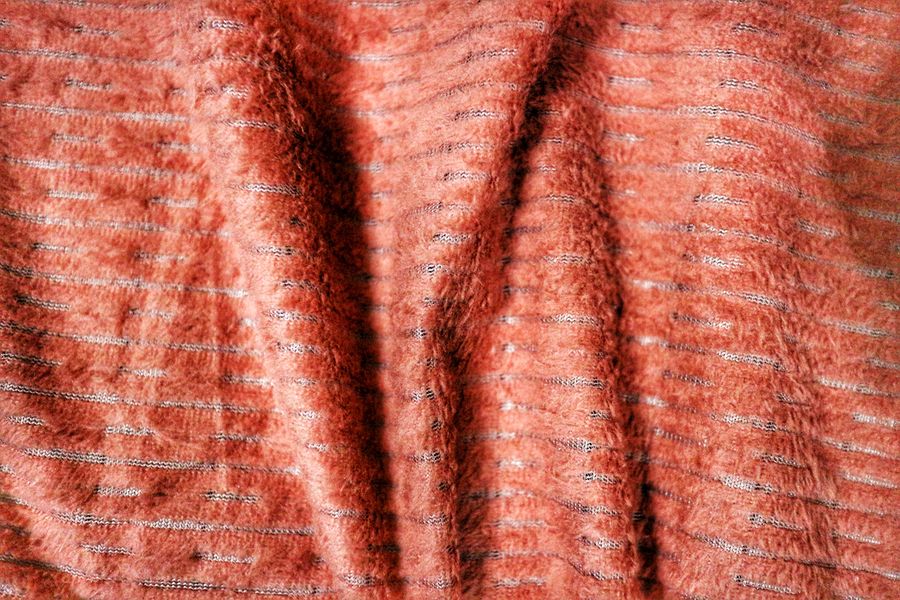
What gauge is counting
Gauge is the number of stitches across a fixed width of knitted fabric, and it is set by the machine the piece was made on. A fine gauge machine puts many small loops into that width. A coarse gauge machine puts in few large ones. The yarn thickness follows from the machine rather than the other way around.
Everything people notice about a knitted garment traces back to that. Fine gauge gives a smooth, dense, thin fabric that can be tailored and worn under a jacket. Coarse gauge gives a thick, open, springy fabric with visible stitch texture, warm because it traps air in the gaps.
Neither is better. They are two different fabrics that happen to be made by the same process, and comparing them is like comparing a poplin with a tweed.
Stretch is stored in the loop, not in the fibre
A knit stretches mainly because its loops can change shape. Pull sideways and each loop flattens and widens; release it and the yarn tries to return. Very little of that movement is the fibre itself stretching, which is a point worth holding onto, because it explains why the same wool behaves so differently woven and knitted.
The consequence is that the amount of yarn in a loop determines how much travel is available. Large loops in a coarse knit have a great deal of slack to give up, so the fabric stretches a long way. Small loops have less, so a fine gauge fabric is comparatively stable.
That is only half the story though, because stretching and returning are separate abilities. Getting long is easy for a knit. Coming back is where the differences appear.
Recovery is where garments are actually lost
Recovery depends on the fibre and on how tightly the fabric was knitted. Wool recovers unusually well because the fibre is naturally crimped and elastic, and because it can be relaxed and reset with moisture. Cotton recovers badly. Once a cotton knit has been stretched under load, a good deal of that deformation stays.
This is why cotton jumpers develop long bodies and drooping cuffs while a woollen one of the same age still sits where it was. It is also why a heavy cotton knit hung on a hanger stretches under nothing more than its own weight, and why knitwear is folded rather than hung.
Tension in the knitting matters too. A loosely knitted fabric at any gauge has more slack to lose and returns less completely than a firmly knitted one, which is why two garments in the same yarn and the same gauge can behave differently after a season.
Where a garment goes out of shape first
Failures cluster at the points that take repeated load. Cuffs and hems stretch because they are pulled over hands and pushed up arms. Elbows bag because the joint is repeatedly flexed and the fabric there is stretched and released thousands of times.
Necklines go for a different reason: they are pulled over the head, which is the largest thing the opening must pass, and that stretch happens under substantial force at a place with no seam to resist it. A neckband knitted in a tighter rib is the usual defence.
Ribbing generally is a shape-holding structure rather than a decoration. Its alternating columns of front and back stitches make it fold in on itself, so a rib pulls in strongly and returns hard, which is exactly what you want at an opening.
Fully fashioned, cut and sewn, and why it matters
A fully fashioned knit is shaped during knitting itself, with stitches added or removed to make the piece narrow at the waist or curve into an armhole. Look for small marks near the seams where the shaping happened. The panel is knitted to its final shape and the loops run uninterrupted around the edge.
A cut and sew knit is knitted as plain fabric and then cut with a blade like woven cloth, and the pieces are stitched together. It is faster and cheaper and it wastes yarn, and it leaves cut loop ends along every seam which must be secured or the fabric will run.
The practical difference shows over time. A fully fashioned seam is joined loop to loop and stretches with the fabric around it. A cut and sewn seam is a line of thread through a stretchy material, and it is a stiffer, weaker line that is where a jumper often gives way.
Judging gauge and construction in the shop
Hold the fabric up to the light. A dense knit will show almost no light through the stitches; an open one will glow. Then stretch a small area gently and let go, watching whether the stitches close back up or leave a slack patch behind.
Check the neckband and cuffs specifically, since they carry the load, and see whether they are ribbed and how firmly. Look inside the shoulder seam for the smooth loop-to-loop join of fashioning or for a cut edge that has been overlocked.
None of this tells you what a garment costs or who made it, and it is not a guarantee. But it will separate a knit that is going to hold its outline from one that will be a different shape by spring, and that distinction survives every change of fashion.
Common questions
Is a thicker jumper always warmer?
Usually but not automatically, because warmth comes from trapped still air rather than from bulk itself. A dense, heavy, tightly knitted fabric can be less insulating than a lighter, lofty one that holds more air. What thickness does reliably provide is wind resistance and durability.
Why do my knits stretch at the shoulders?
Almost always because they have been hung on a hanger. The weight of the whole garment concentrates on two small points of fabric, and over days that load deforms the loops permanently, particularly in cotton and in anything loosely knitted. Fold knitwear instead.
Can a stretched jumper be brought back?
Wool often can, because moisture lets the fibre relax and reset. Washing gently and then drying flat, patted into shape, recovers a surprising amount. Cotton and most blends recover far less, and a bagged cotton knit is generally permanent.
Nikhil writes about fit, fabric, care & repair, mostly the parts other people skip and is unreasonably interested in the detail nobody else checks.