
Fabric
A woven cloth and a knitted one fail in completely different ways
Weaving interlaces straight yarns at right angles while knitting builds a fabric out of loops, and nearly every practical difference between two garments follows from that one distinction.
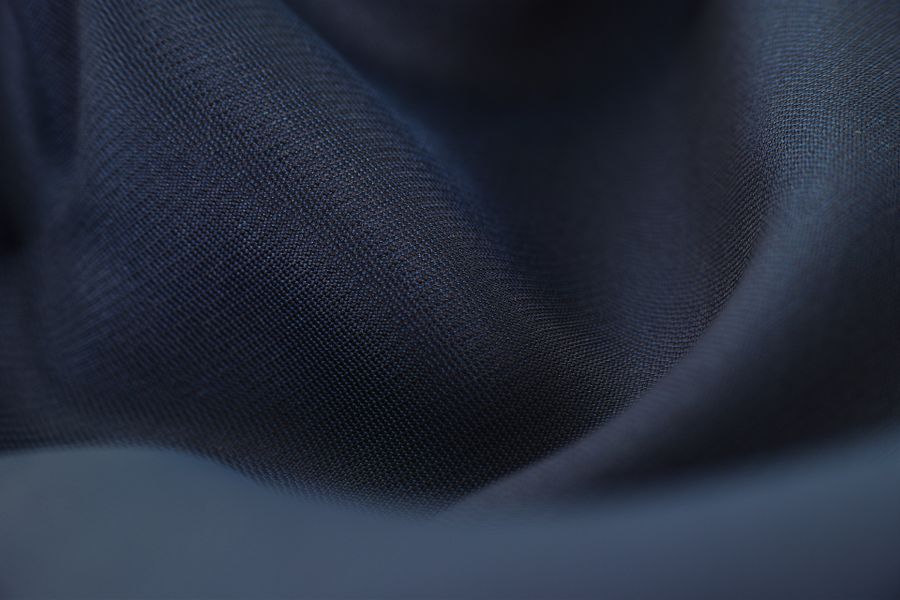
Two ways of turning yarn into cloth
A woven fabric is made from two sets of straight yarns crossing at right angles. The warp runs the length of the cloth and is held under tension on the loom; the weft is passed across it, over and under, in whatever order the pattern requires. Nothing in the structure is curved. The yarns are held in place by friction and by the interlacing itself.
A knitted fabric is one continuous yarn — or a set of them — formed into rows of loops, each row hooked through the row before it. There are no straight lines and no right angles. The whole cloth is a chain of interlocking curves, which is why you can pull a knit in any direction and watch the loops change shape to accommodate you.
Everything below follows from those two pictures. Shirts, suiting, denim and most outerwear shells are woven. Jersey T-shirts, sweatshirts, socks, jumpers and underwear are knitted. The difference is not formality; it is geometry.
Stability against stretch
A woven cloth barely stretches along the warp or the weft, because those yarns are already straight and there is nothing to straighten. Pull diagonally, at forty-five degrees, and it gives noticeably — that direction is the bias, and dressmakers exploit it to make cloth curve around a body without seams doing all the work.
A knit stretches in every direction, because the loops can flatten and elongate long before any yarn is put under tension. This is why knitwear can be pulled over a head without a fastening and why a jersey T-shirt needs no darts to follow a shoulder.
Stability is the flip side of that. A woven garment holds the shape it was cut to, which is why tailoring is done in woven cloth: a lapel, a collar roll and a clean trouser line all require a fabric that will not move when the wearer does.
How each one breaks
Wovens fray. Cut one and the cross yarns at the edge have nothing holding them, so they slide out, which is why every woven seam has to be finished in some way — overlocked, bound, folded or pinked. A woven cloth also tears in a line, following a gap between yarns, so a small snag near an edge can become a long straight rip.
Knits ladder. Break a single loop under load and the loops it was supporting have nothing to hold them, so the failure runs along a line of stitches. Cut jersey and it curls at the edge rather than fraying, because the loops on the face and back of the fabric pull in different directions.
Snagging behaves differently too. A pulled thread in a woven cloth draws in a puckered line and can often be worked back with a fingernail. A pulled loop in a knit takes yarn out of neighbouring stitches and leaves a long slack loop that has to be drawn through to the wrong side.
Bagging is a knit problem
Elbows and knees on knitted garments go baggy because the loops there are being repeatedly stretched and are not recovering fully. Whether they recover depends on the fibre: wool has genuine elastic recovery and springs back, cotton has very little and stays where it was put, which is exactly why cotton jersey elbows and cotton rib cuffs go slack while wool ones mostly do not.
This is also why a cotton knit responds so well to washing. Wetting the fibres relaxes them and lets the loops return towards their original geometry, so a bagged garment often looks restored after a wash. It is not a repair. The same wear will produce the same bagging again.
Woven garments do not bag in the same way, but they do something related. Repeated bending at the knee or elbow deforms the yarns permanently in a small area, which shows as a pale, slightly shiny patch where the fabric has been crushed and abraded rather than stretched.
What it means for repair and care
A hole in a woven fabric can be darned or patched with a piece of the same cloth, because the surrounding material is stable and will hold stitches. A hole in a knit needs the loops picked up and rebuilt, or it needs a patch that stretches with the garment; sew a rigid patch onto jersey and it will tear out along its own edges.
Storage differs for the same reason. A knitted jumper hung on a hanger stretches under its own weight, because the loops at the shoulders are carrying the whole garment and will elongate given long enough. Knits are folded. Wovens hang.
And washing hits knits harder. A tumbling drum stretches and relaxes loops thousands of times in a cycle, working fibre ends loose and encouraging pilling, while a woven cloth mostly just abrades at its surface. Neither escapes wear. They simply arrive at it by different routes.
Common questions
Is a knitted garment less durable than a woven one?
Usually, at comparable quality, because knits stretch under every load and pill more readily. But a densely knitted heavy jumper will outlast a flimsy woven shirt easily. Construction and weight matter more than the category, and a knit is doing a job a woven cloth cannot do at all.
Why does jersey curl at the cut edge?
Because the loops are not symmetrical through the thickness of the fabric. The face and the back are under different tensions, and with no selvedge or seam to hold the edge, the cloth relieves that imbalance by rolling. It is a property of single jersey specifically; double-knit and rib structures are balanced and lie flat.
Can a woven garment stretch at all?
Along the bias, yes, quite considerably, which is why bias-cut garments cling and drape the way they do. Along the warp and weft, very little unless elastane has been spun into the yarn. Most of the give you feel in a fitted woven shirt is the cut moving, not the cloth.
Lukas joined to cover fit, fabric, care & repair and stayed for the awkward questions and reads the small print so you do not have to.