
Fit
The shoulder seam is the one line a tailor would rather not move
Nearly everything else on a jacket is negotiable, but the shoulder is where the garment is assembled, and that is why it decides whether the thing fits.
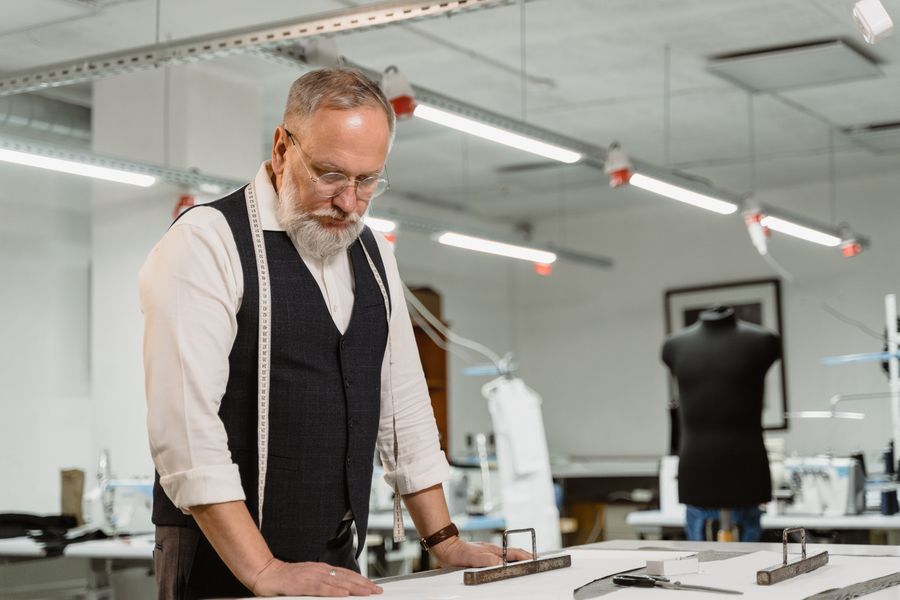
Where the seam is supposed to land
Stand square to a mirror, arms down, and find the bony point where the flat top of your shoulder turns and starts running down into your arm. On a jacket or a structured coat the seam should sit on that point or a whisker outside it. A centimetre either way is nothing. Three centimetres is the difference between a garment that looks made for you and one that looks borrowed.
Outside that narrow band the eye registers the error long before it can name it. A seam that has slipped down the arm reads as a jacket sliding off the body: the sleeve head collapses into a soft roll and the whole thing looks a size too big even when the chest is correct. A seam sitting inboard of the bone hauls the sleeve up instead, so that diagonal creases run outwards from the base of the neck.
Shirts are more forgiving, though only because they are unstructured. A shirt shoulder can sit slightly wide without looking wrong, since there is no canvas to hold the mistake in place. A dropped shoulder on a sweatshirt is not a mistake at all — the seam has been deliberately relocated and the pattern redrawn around its new position.
The shoulder is where a jacket is actually built
The shoulder is not just the place two pieces of cloth meet. On a tailored jacket it is the assembly point for the front panel, the back panel, the collar, the canvas that gives the chest its shape, and usually a pad or a strip of wadding smoothing the transition into the sleeve. The top of the sleeve is cut longer than the hole it goes into, and that surplus is eased in with tiny gathers so the arm can rotate without dragging the body after it.
All of that geometry is fixed at the pattern stage and stitched down early in construction. By the time a jacket reaches a shop floor, the shoulder is the most heavily built area of the garment, holding four or five layers in a settled relationship. That is why the shape survives years of wear, and why it resists being changed.
The rest of the jacket is loose engineering by comparison. The waist is a curve on a side seam. The back has a centre seam. Those are single lines of stitching through two layers of cloth, and a competent alterations tailor can move either without disturbing anything structural.
What moving it actually involves
To narrow a jacket at the shoulder, the sleeve has to come off. That means unpicking the armhole, releasing the lining, freeing the collar where it meets the seam, taking the seam in, redrawing the armhole so it is still a smooth curve, and easing the sleeve head back into an opening that is now a different shape and a different circumference.
None of that is impossible. Good tailors do it, and do it well. But it is several hours of skilled work, it carries a real chance of the finished shoulder sitting slightly off, and on an inexpensive jacket the labour costs more than the garment did. Letting a shoulder out is harder still.
There is a hierarchy worth committing to memory. Sleeve length, trouser hems, waist suppression and tapering are routine and low risk. Sleeve pitch and jacket length sit in the middle. Shoulders, armhole depth and anything altering how the collar meets the neck are the expensive end, and no amount of money makes them entirely safe.
A wrong shoulder breaks things below it
A shoulder that is too wide does not simply look wide. It drags the armhole down and outwards, and a low, wide armhole restricts the arm rather than freeing it. Raise your arm in a jacket like that and the whole garment lifts, because the only slack available has to come from the chest and the back.
A shoulder that is too narrow pulls the other way. The sleeve head is compressed into a hole too small for it, the cloth across the upper back is under tension whenever you lean forward, and in time the seam shows wear along its length because it is carrying a load it was never cut to carry.
Both errors also break the collar. A collar is supposed to sit flat against the back of the neck with no gap above the shirt, and it can only manage that while the shoulders hold the jacket where the pattern assumed. A gap that appears when you are standing still is far more often a shoulder problem than a collar problem, which is why having the collar taken in so rarely fixes it.
Buying around the constraint
The practical conclusion is unglamorous. When choosing between two jackets, fit the shoulders first and treat everything else as negotiable. A jacket right across the shoulders and two sizes too generous through the waist is an afternoon of straightforward work. A jacket that skims the waist and is wrong at the shoulder will be wrong for as long as you own it.
The same logic scales down through a wardrobe. On an overcoat the fixed points are the shoulders and the chest. On a shirt they are the shoulder and the neck, since the body can be taken in cheaply from the side seams. On trousers the fixed point is the rise rather than the waistband, which surprises people.
None of this claims that clothing cut for an average body can be made to fit like something cut for yours. It cannot. But most of the visible distance between a garment that looks right and one that does not comes down to a handful of load-bearing measurements, and being stubborn about those in the shop costs nothing.
Common questions
Can a jacket shoulder ever be altered successfully?
Yes, and a skilled tailor will do it if the garment justifies the bill. It is most successful on a soft, lightly structured jacket with little padding, and least successful on a heavily canvassed one where the shape has been pressed in over years. Ask for the price before the opinion, because the price usually contains the opinion.
My shoulder seam sits right but the sleeve twists. Why?
That is sleeve pitch — the angle at which the sleeve hangs out of the armhole, rather than where the seam sits. Arms do not hang straight down; most hang slightly forward, and if the sleeve was set for a different angle you get diagonal ripples on the front or back of the upper arm. It is a moderate alteration and much cheaper than a shoulder.
Do shoulder pads mean a jacket is badly made?
No. A thin pad is a shaping device, not a disguise, and most tailored jackets contain something at the shoulder even when they look entirely soft. The complaint people actually have is with pads that extend the shoulder line well past the wearer's own, which is a design decision rather than a fault in construction.
Amrita has been reporting on fit, fabric, care & repair since long before it was fashionable and reads the small print so you do not have to.