
Fit
Seam allowance is the budget every alteration has to spend
A garment can only be let out as far as the cloth folded inside it allows, which is why the same alteration is trivial on one jacket and impossible on another.
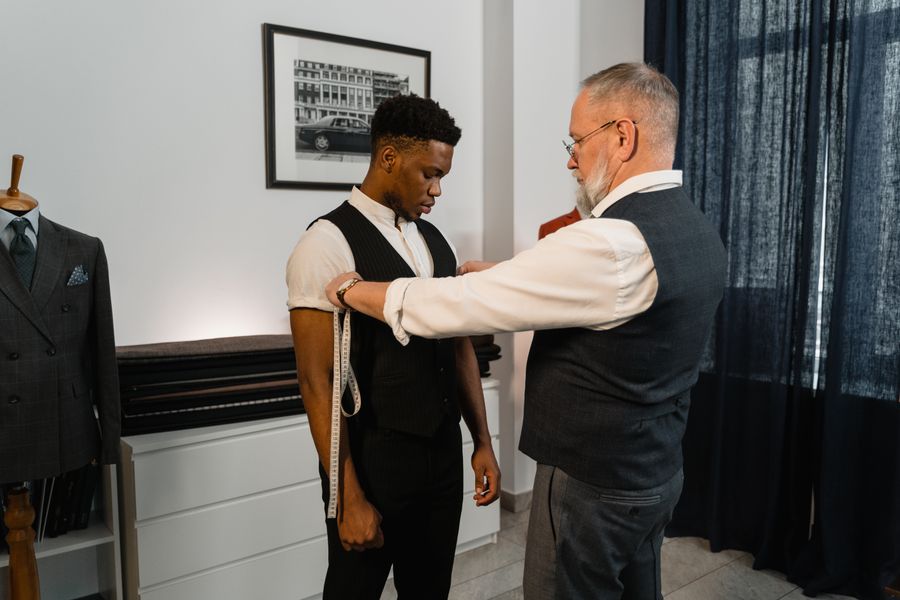
The cloth you never see
Every seam in a garment has cloth folded away behind it. Two panels are laid together, stitched a set distance in from their raw edges, and then opened out; the strip between the stitching and the edge is the seam allowance, and it lives inside the garment for its whole life. It is the only material a tailor has to work with when something needs to be made larger.
How much is in there varies enormously and it is not random. Mass-manufactured clothing is cut to use as little cloth as possible, so allowances are often around a centimetre, sometimes less, and frequently the edges have been trimmed and overlocked together into a single bound edge. Tailored clothing intended to be altered carries deliberate inlays — extra width at the centre back of a jacket, at the trouser seat, at the side seams — precisely so that a fitter has somewhere to go.
That difference is invisible from the outside and it decides more about a garment's future than the fibre content does. Two jackets that look identical on a rail can have completely different alteration prospects.
Taking in is cheap, letting out is not
Making something smaller is a matter of stitching a new line further in from the old one. There is always room to do that, so the constraint is not cloth but shape: take in a side seam too aggressively and the silhouette distorts, the pockets end up in the wrong place relative to the body, and the armhole is pulled out of true.
Making something larger requires that somebody left you the cloth. Open the seam, press it flat, restitch closer to the edge and you have gained the difference — but only up to whatever the allowance was. When it runs out, it runs out, and there is no clever way around it.
This asymmetry is why the old advice to buy slightly large and have it fitted still holds. It is not that a large garment fits better. It is that reducing is a solved problem and increasing depends entirely on a decision the manufacturer made months earlier.
What letting out leaves behind
Even where there is enough allowance, letting out a seam is rarely invisible. The original stitching has left a line of needle holes through the cloth, and in a dense woven fabric those holes stay visible after pressing, sometimes permanently. In a fine worsted wool they can look like a faint dotted seam running down the garment.
There is also a fade line. The part of the cloth that was exposed to light, air and washing has aged; the strip folded inside has not. On a dark or strongly dyed fabric, the newly exposed strip can be noticeably deeper in colour, and on a much-worn pale garment the reverse is true. Neither corrects itself quickly.
And cloth has memory. Wool in particular takes a set from being pressed, so a hem that has been turned up for five years carries the crease of that hem, and a seam that has been pressed one way resists lying the other. A good presser can reduce this a great deal with steam. Reduce, not erase.
Where to look before you buy
You can assess a garment's alteration budget in a fitting room in under a minute, and it is worth doing on anything expensive. Turn a trouser leg inside out at the hem and see how much cloth is turned up: three or four centimetres means the leg can be lengthened, one centimetre means it cannot. Look at the centre back seam of a jacket and feel for the thickness of the inlay through the lining.
Check whether the seams are overlocked. A seam whose two allowances have been trimmed together and wrapped in thread has been finished for speed, and while it can still be let out slightly, the usable cloth is what sits beyond that binding. Open, pressed seams with clean edges are the sign of a garment built with alteration in mind.
On knitwear the question barely applies. Most knitted garments are either fully fashioned, where the pieces are knitted to shape with no cut edges, or cut and sewn with tiny allowances that unravel if you disturb them. Knitwear is bought to fit, not adjusted into fitting, which is worth knowing before you fall for a jumper a size out.
Thinking of it as a budget
The useful mental model is simply this: at the moment a garment is made, a fixed quantity of adjustability is sewn into it, and every alteration spends some of that down. Once spent, it does not come back. A jacket let out to its limit is a jacket that can never accommodate another change, and if your measurements move again in a few years, the answer will be a new jacket.
Spending it deliberately is a reasonable way to think about clothes you intend to keep. It also argues for making one careful set of alterations rather than a series of small ones, since each visit costs cloth as well as money and repeated unpicking is hard on the fabric around the seam.
None of this makes a garment with generous inlays automatically the right purchase. Plenty of well-made clothing is cut close to the bone because that is how the maker works, and plenty of poorly made clothing has wide seams. But if you are choosing between two similar things and one of them has a future, that is not nothing.
Common questions
How much can a jacket usually be let out?
As a rough guide, a couple of centimetres at the waist through the side and centre back seams, when the maker has left inlays. Some tailored jackets carry considerably more; many inexpensive ones carry almost none. There is no way to know from outside the garment, so the only honest answer is that a tailor has to look.
Will the old stitch line always show?
Not always, but often enough to plan for. Loosely woven, textured and matte cloths hide the marks well; smooth worsted wools, tightly woven cottons and anything with a sheen show them most. A skilled presser with steam will improve it, and on a garment worn under a jacket it may not matter at all.
Is it worth altering inexpensive clothing?
Sometimes, if the alteration is cheap and the garment is one you wear constantly. A hem or a taper on trousers you wear weekly is easily worth it. Anything involving the shoulder, the armhole or a full reconstruction almost never is, because the labour is priced by skill and time rather than by what the garment cost.
Nikhil writes about fit, fabric, care & repair, mostly the parts other people skip and is unreasonably interested in the detail nobody else checks.