
Care & Repair
Where you keep clothes matters as much as what you keep them in
Damp, light and still air do slow damage to garments that are not being worn at all, and most of it is invisible until the season comes round again.
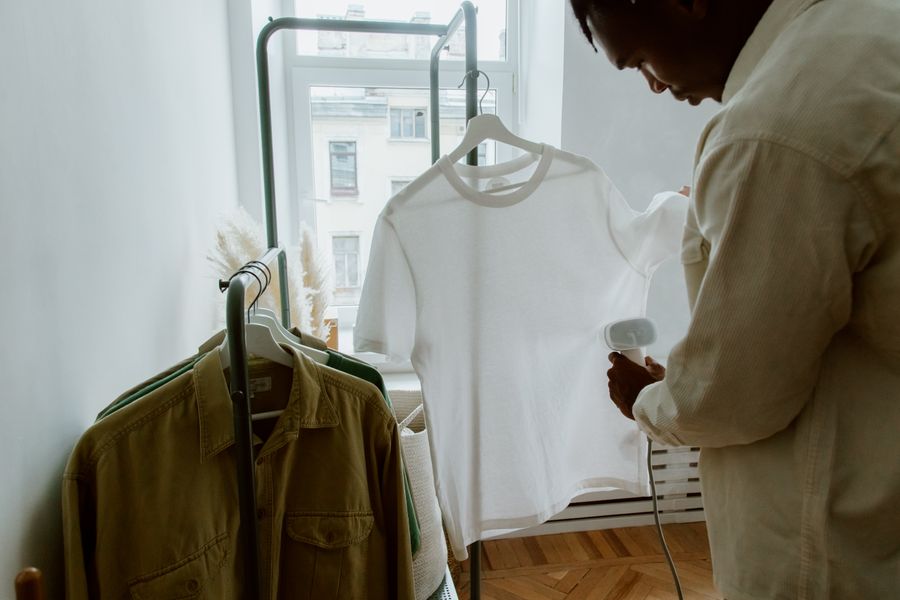
Clothes deteriorate while nothing is happening to them
It is easy to think of wear as the only thing that ages a garment, since wear is visible and attributable. But a wardrobe is an environment, and cloth left in a bad one for six months can come out weakened, discoloured or smelling in ways that have nothing to do with anybody having worn it.
Three environmental factors do nearly all of this: moisture, light and the absence of moving air. They act slowly and they compound, which is why the damage tends to be discovered all at once when something is taken out and unfolded.
The good news is that all three are cheap to manage. Storage is one of the few areas of garment care where doing the right thing costs almost nothing and doing the wrong thing is expensive.
Humidity is the first thing to get right
Mould and mildew need moisture, and they will grow on the finishes, sizings and soil present on cloth rather than needing to digest the fibre itself, although given time they will damage the fibre too. The characteristic result is a musty smell, then grey or black speckling that is often permanent because the growth has stained the fibre.
Cellulose fibres are the most vulnerable, since cotton and linen absorb moisture readily and hold it. Protein fibres are also at risk, and synthetics are largely immune, though anything stored with them will still smell of the cupboard.
Very dry air causes its own problems at the other extreme, making leather brittle and natural fibres less pliable, though in most homes excess moisture is the more likely condition. Basements, lofts, garages and cupboards on outside walls are the usual offenders, and a room used by people is generally a better bet than one that isn’t.
Air has to be able to move
This is the argument against plastic. A garment sealed in polythene cannot exchange moisture with the air around it, so anything damp when it went in stays damp, and the plastic itself can off-gas and yellow fabric over long periods. Dry cleaner bags are transport packaging and were never storage.
Cotton or linen covers do the opposite job well: they keep dust and light off while allowing the garment to breathe. For folded storage, a cardboard box or a fabric container beats a sealed plastic crate for the same reason, with acid-free tissue between layers for anything valuable.
Crowding works against airflow too. A rail packed so tightly that garments compress each other holds moisture between them, prevents anything drying out, and presses creases in. Leaving space isn’t fussiness; it’s the mechanism by which everything else works.
Light fades what it can reach, including through a window
Ultraviolet light breaks down dye molecules and, given long enough, the fibres themselves. A garment stored on an open rail in a room with daylight will fade along whichever face is exposed, and the fade line at a fold is a familiar and irreversible sight on anything left out for a season.
Silk and wool are more sensitive than cotton, and dark and bright colours show the loss more obviously than pale ones. Fluorescent lighting contributes a small amount of ultraviolet as well, which matters for very long-term storage rather than for a normal cupboard.
The remedy is trivial: a closed cupboard, a garment cover, or a box. If clothes must live on an open rail, keeping them out of direct sun and rotating what hangs at the exposed end will spread the effect rather than concentrating it on three items.
Practical arrangements for a season
Everything should be clean before it goes away. Body oils, food residue and perspiration oxidise over months into yellow-brown stains that were invisible when the garment was put away, and they are much harder to remove once set. This is the single most common reason a stored garment comes out marked.
Fold knits and anything heavy; hang structured garments on broad hangers with room around them. Support the shapes that will not survive being flattened, and refold folded items at least once mid-season if they are stored for a long time, since a crease left permanently in the same place weakens the fibre along the fold.
And check on things occasionally. Long-term storage that is never opened is exactly where a humidity problem develops undetected, and a two-minute look every few months costs nothing and catches the damp cupboard before it has done anything that cannot be undone.
Common questions
Can mildew be removed from fabric?
Sometimes. Brushing the growth off outdoors when dry, then washing thoroughly, removes a good deal of it, and sunlight and air help with the residual smell. The staining is often permanent, because the growth has coloured the fibre rather than sitting on it, and repeated washing at that point does more harm than good.
Are vacuum bags a bad idea?
They are useful for bulk and poor for garment health. Compression flattens loft in anything insulated or knitted, sometimes permanently, and the sealed environment traps whatever moisture was present. For a spare duvet over a summer they are fine; for wool knitwear or a down jacket over years they are not.
Does a wardrobe need ventilation?
It benefits from it. Opening doors occasionally, leaving a gap behind a wardrobe standing against an exterior wall, and not packing garments hard against each other all help air exchange. Where a room is persistently damp, a moisture absorber inside the cupboard is a reasonable measure and needs replacing to keep working.
Tara has written about fit, fabric, care & repair for most of the last decade and prefers a plain explanation to a clever one.