
Fit
A dart is how flat cloth is persuaded to become a body
Fabric comes off the loom flat and nobody is, so the wedges folded out of a pattern are what bridge the gap — and they explain most of what a size chart cannot.
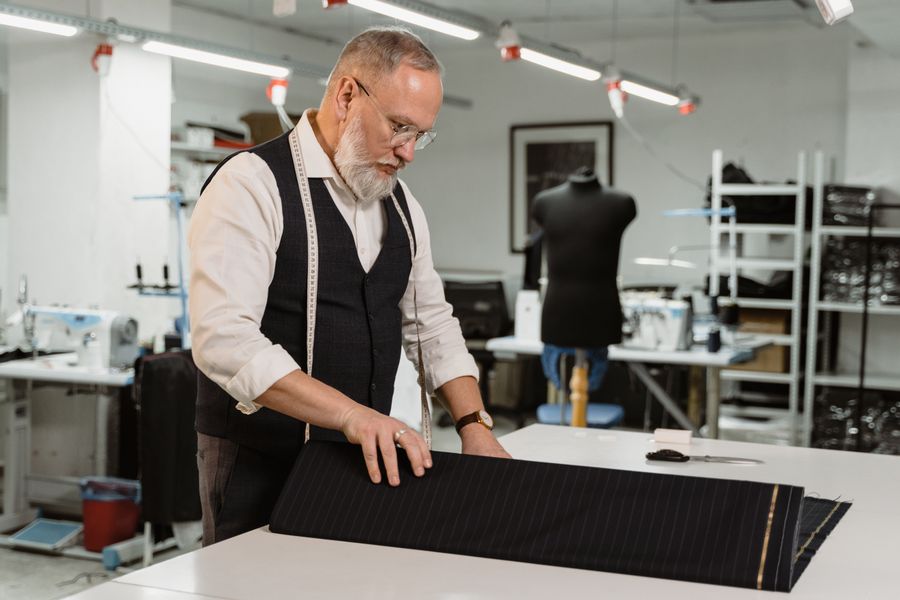
Flat cloth, curved body
Woven fabric is a flat plane. A torso is a set of compound curves. There is no way to wrap the first around the second without either creating slack somewhere or removing some, and the dart is the oldest and most direct method of removing it.
A dart is a wedge of cloth folded out and stitched down, wide at the seam and tapering to a point. Take out that wedge and the surrounding fabric is forced into a shallow cone. Put enough cones in the right places and a flat piece becomes a garment that follows a body.
Everything else that shapes a garment is a variation on the same idea. Gathers are many small darts. A curved seam is a dart opened out and moved to an edge. Steaming and shrinking wool into shape, which is how a good jacket chest is built, is a dart achieved without cutting anything.
Where a dart points is where it works
A dart shapes around its apex, the point at which it ends. On a bust dart the apex should stop short of the fullest part of the bust, typically by a couple of centimetres, because a dart running all the way to the point produces a hard conical tip instead of a curve.
This is among the most common fitting faults in ready-to-wear, and it is not really a manufacturing error so much as a consequence of averaging. Patterns are drafted for an assumed apex position. Bodies vary in where that point actually sits, both in height and in how far apart the two points are.
When the apex is wrong the symptoms are legible. Drag lines radiate towards the fullest point from wherever the cloth has run short. Fabric pools above or below the dart when the apex sits too low or too high. The dart itself visibly points at nothing.
Darts can be moved, split and hidden
A dart can be rotated around its apex to almost anywhere on the edge of the pattern piece without changing how much shaping it delivers. The same wedge taken from the side seam, the shoulder, the armhole or the waist produces the same cone in the middle.
That freedom is why darts appear in such different places on garments that fit identically. A side bust dart, a French dart running diagonally up from the hip, a shoulder dart, or no visible dart at all because the shaping has been absorbed into gathering or into a seam.
A dart can also be split into two or three shallower ones, which distributes the shaping and produces a softer, rounder result. Deep single darts give a more defined shape and can look severe in stiff cloth.
Why two people of the same size fit differently
The depth of a dart corresponds to the difference between two circumferences — how much larger the full bust is than the ribcage beneath it, or the hip than the waist. That difference is what the dart absorbs.
Two people can share a full bust measurement and have quite different ribcages, which means they need the same size garment and quite different dart depths. Ready-to-wear can only choose one, and it chooses an average. The person whose difference is larger finds the front pulling upwards and the hem riding; the person whose difference is smaller finds slack and folds.
Trousers and skirts have exactly the same problem at the waist-to-hip step. It is why two people can both be a perfect fit at the hip and only one of them ends up with a gaping waistband.
Princess seams do the same job with more room to adjust
A princess seam runs vertically through the shaping area, from the shoulder or the armhole down towards the hem. It is not a decorative line; it is shaping distributed along a curve rather than concentrated into a wedge.
The practical advantage is adjustability. A seam can be let out or taken in along its length, moved more in one place than another, and reshaped without disturbing the rest of the garment. A dart can only be deepened or made shallower, its effect is more localised, and it carries little spare cloth.
For anyone who expects to have things altered, a garment with vertical seams running through the body is usually more cooperative than one shaped with darts alone, and it will accept a change in body shape over the years with less argument.
Reading darts in a fitting room
Stand still, arms down, and look for lines rather than going by feel. Diagonal creases point towards the place where the cloth has run short. Horizontal folds sit above or below shaping that is in the wrong position. A dart end that dimples is one taken too deep for the cloth it is in.
Then move. Raise the arms, sit down, reach forward. Shaping that looks right standing still and pulls immediately on movement was drafted with too little ease around the dart, and no alteration will fully fix that.
Most dart adjustments are within reach of a competent alteration tailor, which is not true of most armhole and shoulder work. It is one of the cheaper ways to make an ordinary garment look considered.
Common questions
Why does my shirt pull at the bust even in a larger size?
Because the problem is usually shaping rather than circumference. If the dart is too shallow, or its apex is in the wrong place, going up a size adds cloth everywhere without adding it where the body actually needs it. The larger shirt then hangs loose at the shoulder and still pulls across the front.
Are darts a sign of better construction?
Not on their own, though a garment with no shaping at all is either a deliberately loose cut or a cheap one. What indicates care is whether the shaping suits the cloth: split darts and curved seams in soft fabric, cleaner single darts in crisp fabric, and dart ends pressed properly rather than dimpling.
Can a dart be added to a garment that has none?
Yes, and it is a common alteration at the back waist of a shirt or jacket to remove billowing. Adding shaping at the front is more delicate, because it changes the balance of the garment and can shorten the front hem. A tailor will normally pin it on you rather than work from a measurement.
Lukas joined to cover fit, fabric, care & repair and stayed for the awkward questions and reads the small print so you do not have to.