
Wardrobe
Buying clothes remotely is measurement work, not guesswork
Without a fitting room the only reliable information is numbers, and a short set of measurements taken from garments you already own removes most of the risk.
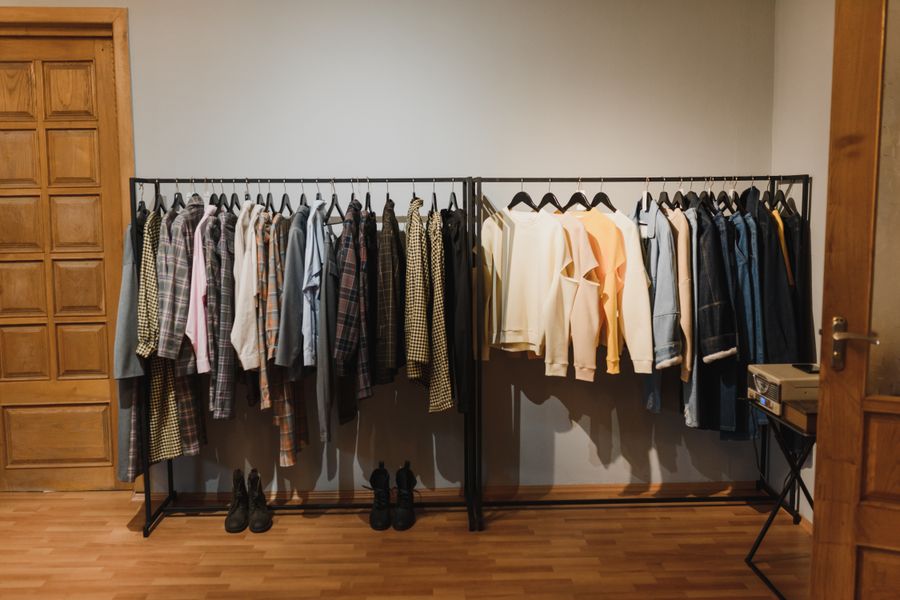
The label tells you almost nothing
A size name is a manufacturer’s internal shorthand. It refers to a body measurement in some ranges, a garment measurement in others, and to nothing consistent across companies, countries or even product lines within one company. Buying by size name at a distance is therefore a bet with poor odds.
What does carry information is a flat measurement: the actual width of the garment across the chest, laid flat, in centimetres. That number is unambiguous, it can be compared directly against something you already own, and it includes the ease the designer intended without you having to guess at it.
Sellers who publish a full measurement table are handing you the tool. Sellers who publish only a body measurement chart are telling you which body they think fits the garment, which is one step further from what you need but still usable.
Measure a garment you already like
The single most useful thing in remote buying is a set of numbers taken from garments that fit well. Lay the item flat, smooth it without stretching, and measure across from seam to seam rather than around.
For a shirt or a jacket that means chest width at the base of the armhole, shoulder seam to shoulder seam across the back, sleeve from shoulder seam to cuff edge, and full length from the base of the collar. For trousers it means waist across the flat, front rise from crotch seam to top of waistband, inseam, thigh width just below the crotch, and leg opening at the hem.
Write them down and keep them somewhere retrievable. Once you have them, most remote purchases become an arithmetic comparison rather than a hope, and the ones without published measurements can be ruled out quickly.
Fabric changes what a measurement means
The same chest measurement behaves very differently in a rigid woven cotton and in a knit with elastane. A knit can be several centimetres narrower than your reference garment and still fit comfortably, because it stretches and returns. A stiff woven cannot borrow anything at all.
Weight matters similarly. A heavy cloth needs slightly more room than a light one at the same nominal fit, because it does not drape into the space around the body in the same way, and a heavy garment cut close feels tighter than its numbers suggest.
This is why composition and weight are worth reading alongside the measurement table. Two garments with identical numbers in different cloths are not the same garment, and no size chart captures that.
Returns are the mechanism, and they have costs
Remote buying works partly because returns absorb the residual uncertainty, and ordering two sizes with the intention of returning one is a rational response to unreliable sizing. It is also a genuinely expensive practice in aggregate, since returned garments require transport, inspection and reprocessing, and some proportion never returns to sale at all.
The costs are real even when they are not charged to you directly, and they are one of the reasons sizing information has improved: a seller with accurate measurements published gets fewer returns. Rewarding those sellers by buying from them is a reasonable response.
It is also worth checking the terms before ordering rather than after. Return windows, who pays postage, and whether altered or washed items are accepted vary considerably, and the answers change whether an uncertain purchase is worth attempting.
A short routine that removes most of the risk
Keep your reference measurements to hand. Filter out anything without a published measurement table, since it is not worth the trouble. Compare the two or three dimensions that cannot be altered — shoulder width, rise, leg opening — more carefully than the ones that can.
Read the composition and weight, and adjust your expectation of the numbers accordingly. Where a garment sits between two sizes, take the larger one for anything structured and the smaller one for anything knitted, since a knit that is slightly small will accommodate and a jacket that is slightly small will not.
And when a garment arrives and fits, measure it before wearing it and add it to your list. A wardrobe of known numbers is the actual asset here, and it accumulates quietly over a couple of years into something that makes remote buying about as reliable as a fitting room.
Common questions
Should I measure my body or my clothes?
Both are useful and garment measurements are more directly actionable. Body measurements tell you nothing about how much room a designer intended; garment measurements include that decision already. Keep body measurements for filling in size charts, and garment measurements for comparing one item to another.
What if a seller only publishes body measurements?
Use them, and treat them as less precise. A body chart tells you which body the maker had in mind, which combined with the garment description gives a reasonable estimate. Where the item is expensive or hard to return, asking the seller for a flat chest measurement is a perfectly ordinary request.
Is ordering multiple sizes reasonable?
It is a rational response to inconsistent sizing, and it carries real costs in handling and transport that are borne somewhere even when they are free to you. Reserve it for genuinely uncertain purchases rather than making it a default, and favour sellers whose published measurements make it unnecessary.
Marta covers fit, fabric, care & repair and the questions readers actually send in and is happiest when a piece answers the question completely.