
Fabric
Colour fades three different ways and only one is the dye's fault
A garment loses its colour to light, to washing and to rubbing, and the three processes look different, happen in different places and call for different defences.
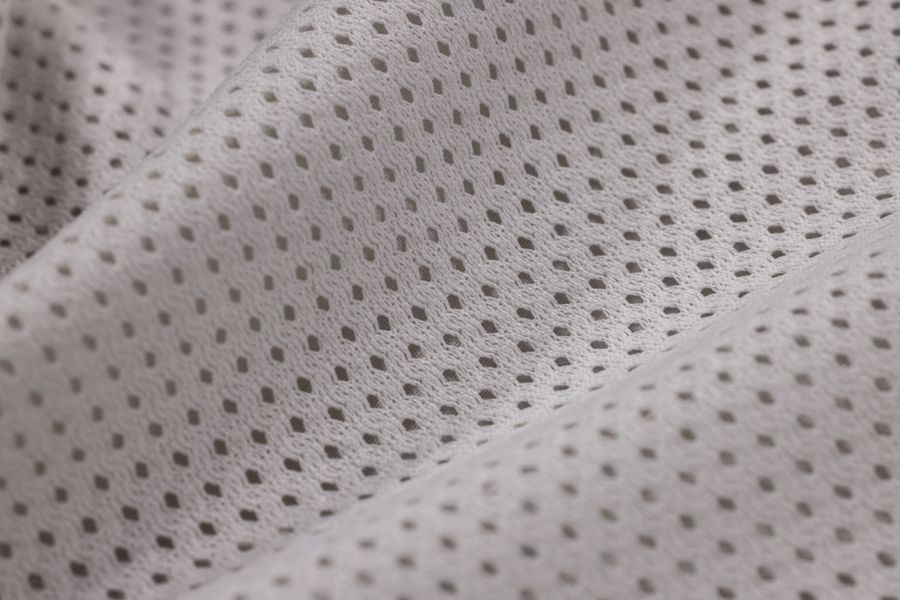
Dye is a chemical relationship, not a coating
A dye is not paint sitting on the surface of a fibre. It is a molecule that has to get inside the fibre and stay there, held by chemical bonds, by physical entrapment, or in the strongest cases by an actual covalent link formed between dye and fibre.
How strong that relationship is decides everything about how the colour behaves later. Different fibres accept different dye classes, which is why a cotton and polyester blend often has to be dyed twice with two chemistries, and why the two components can fade at different rates and leave a garment looking slightly off.
Colourfastness is the general name for how well the colour resists being removed, and it is measured separately against light, washing and rubbing, because those three attack it in entirely different ways.
Light breaks the dye molecule apart
Ultraviolet light carries enough energy to break chemical bonds, and dye molecules are large organic structures with plenty of bonds to break. When one comes apart it stops absorbing the wavelengths that made it look coloured, and the fabric goes pale.
This is why fading from sunlight is uneven and shows exactly where the light fell. A jacket faded across the shoulders, a curtain pale down one edge, a shirt lighter on the side that faced a window at a desk. It also explains why the fibre underneath is usually undamaged at first while the colour has clearly gone.
Dark and bright colours generally show it soonest, and some dye classes are markedly more light-stable than others. There is no way to reverse it, and drying clothes in strong sun is a slow and reliable way of causing it. Turning garments inside out to dry is not superstition.
Washing removes what was never fully attached
The colour that comes out in the first few washes is mostly surplus. It is dye that was in the fibre but never properly bonded or fixed, and it is meant to be removed during finishing at the mill. When rinsing has been skimped, the customer does the rinsing.
Beyond that, hot water and alkaline detergent both loosen dye that is held by weaker bonds, and agitation helps carry it away. This is why washing cool and washing less often preserve colour far better than any product claim, and why a garment washed after every single wearing looks tired in a season.
The dye that leaves has to go somewhere, which is the actual mechanism behind colour transfer in a mixed load. A new dark cotton garment sheds loose dye into the water, and light fabric in the same drum absorbs it.
Rubbing takes the colour off mechanically
Crocking is dye lost by friction, and it is the third and most localised process. Colour rubs off onto skin, onto a bag strap, onto a pale car seat. It happens most where dye sits near the surface rather than penetrating the fibre.
Indigo on denim is the extreme case and a deliberate one. Indigo binds only weakly and stays near the outside of the yarn, so it wears away exactly where the fabric is rubbed, which is the mechanism producing the pale knees, seat and pocket edges that people pay for.
Elsewhere it is a defect rather than a feature, and it is worst on deep dark shades on cotton, on pigment-dyed and garment-dyed pieces, and on anything printed. Wet crocking is far worse than dry, which is why a dark garment rubs off badly on a hot day.
What actually slows all of this down
The three defences are dull and effective: wash less often, wash cooler and gentler, and dry out of direct sunlight. Turning things inside out protects the visible face from both light and abrasion, and it costs nothing.
Wash new dark items separately for the first few cycles, or with something you do not mind. A dye-catching sheet in the drum genuinely does absorb loose dye and is worth using in a mixed load.
Anything that removes soil aggressively removes dye alongside it. Bleach obviously, but also strong stain removers and long hot cycles, all of which are just slower versions of the same chemistry.
Judging colourfastness before you buy
Some of it is guessable. Deep saturated shades on cotton — black, navy, red — carry the most dye and the most surplus, and they will bleed and fade more than a pale or a mid-tone. Pigment-dyed and washed-look garments are designed to fade and will.
Polyester tends to hold colour well against washing, because disperse dye sits locked inside a fibre that water barely enters. Wool holds it well too. Rayon and viscose are less predictable, and printed surfaces are only as durable as the print.
None of this is a guarantee, and dye quality varies within any fibre. But knowing which of the three failures you are looking at tells you whether the fix is where you dry the garment, how you wash it, or simply not wearing it with a pale coat.
Common questions
Why did my new black jeans mark a light-coloured sofa?
That is crocking — surface dye transferring by friction. Indigo and deep sulphur blacks on cotton sit close to the outside of the yarn and rub off, especially when the fabric is damp or the weather is warm. Washing a couple of times before wearing removes the worst of the surplus.
Does washing inside out really preserve colour?
Yes, for two of the three fading routes. The visible face is protected from abrasion against the drum and other garments, and from sunlight during drying. It has no effect on dye lost chemically into the wash water, so it helps but does not solve everything.
Can faded clothes be re-dyed at home?
Sometimes. Home dyeing works reasonably on cotton, linen and viscose, less well on wool and silk, and essentially not at all on polyester, which needs heat and pressure a domestic setting cannot supply. Sewing thread is often polyester even in a cotton garment, so seams frequently stay the old colour.
Lukas joined to cover fit, fabric, care & repair and stayed for the awkward questions and reads the small print so you do not have to.