
Fabric
Finishing is the last thing done to cloth and it changes what you can feel
Between the loom and the cutting table a fabric passes through treatments that alter its hand, its stability and its behaviour more than the fibre choice does.
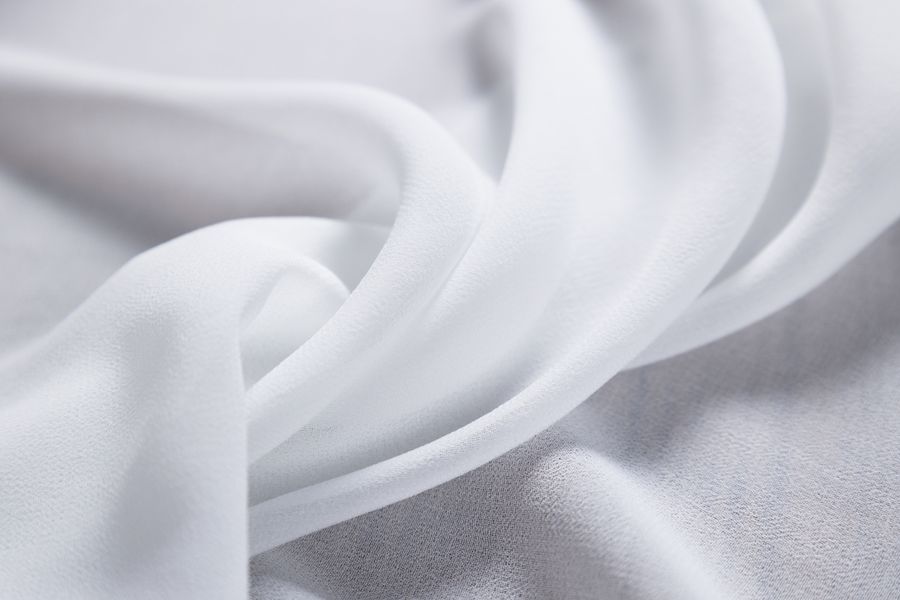
Cloth leaves the loom in an unusable state
Fabric as it comes off a loom is called greige, and it isn’t a product. It carries sizing applied to the warp yarns so they could survive weaving, along with natural waxes, oils and whatever else has come along for the ride, and it’s dimensionally unstable in the sense that it will move the first time it meets water.
What happens next is a sequence of wet and dry processes: singeing the surface fuzz off with a flame, washing the sizing out, bleaching, dyeing or printing, and then a series of treatments applied to give the finished cloth its intended character. That sequence is finishing, and it’s where a mill differentiates its cloth from another mill using the same yarn.
This is the part of textile production that consumers almost never hear about, though it accounts for a good deal of the cost, most of the water and energy used, and a large share of why two cotton shirts feel nothing alike.
Mechanical finishes rearrange the surface
Calendering passes the cloth between heated rollers under pressure, flattening the yarns and producing a smooth, closed, sometimes glazed surface. Brushing or napping does the reverse, dragging fine wires across the surface to pull fibre ends out of the yarn and raise a soft nap, which is how flannel is made from an ordinary woven cloth.
Sueding uses abrasive rollers to produce a much shorter, denser surface fuzz, giving the peach-skin hand found on some cottons and synthetics. Shearing cuts a raised surface to an even height. Emerising, embossing and moiré all work by pressing or abrading a pattern into the cloth.
The important thing about mechanical finishes is that most of them are, to varying degrees, temporary. A raised nap flattens with wear and washing, a calendered glaze dulls, and an embossed pattern in a fabric without thermoplastic fibre gradually relaxes. The cloth reverts towards what it was.
Chemical finishes change how the fibre behaves
Mercerisation is the best known: cotton yarn or cloth is treated with a strong alkali under tension, which swells the fibre, makes its cross-section rounder and permanently increases its lustre, its strength and its ability to take up dye. It is a genuine change to the fibre, not a coating, and it does not wash out.
Resin finishes cross-link cellulose so the fibre cannot rearrange itself into a crease, which is the basis of easy-care cotton. They work, and they cost tensile strength and abrasion resistance in exchange, which is a real trade rather than a free improvement.
Then there is a long list of applied treatments: water repellents, flame retardants, antimicrobial agents, softeners. These sit on or in the fibre and are consumed by washing and wear at very different rates. A finish that survives fifty washes and one that survives five will look identical in the shop.
Pre-shrinking is a finish and a fairly recent one
A woven cloth is under tension throughout weaving and finishing, and the yarns are held straighter than they want to be. Wet them and they relax into a more crimped state, taking up less length, which is the relaxation shrinkage that ruins a garment on its first wash.
Compressive shrinkage processes solve this by physically forcing the cloth into a shortened state before it is sold, feeding it against a rubber blanket that compresses it lengthwise so the shrinkage has already happened. Labels describing a fabric as pre-shrunk are usually referring to something of this kind.
Pre-shrinking reduces subsequent movement and rarely eliminates it, particularly in knits, where the loop structure has far more freedom to change shape. A garment that shrinks steadily over several washes is usually a knit relaxing, which is a different mechanism from wool felting.
What this means when you have a fabric in your hand
A great deal of what people attribute to fibre or to a brand is finishing. Two shirts of the same cotton, the same weight and the same weave can differ in smoothness, sheen, softness and drape entirely because of what was done in the last stage, and only one of them may keep those qualities after a season.
The practical test is to consider whether a quality you like is structural or applied. Smoothness that comes from long-staple yarn and a dense weave will last. Smoothness that comes from a softener and a calendering pass will not, and the garment you buy will not be the garment you own in six months.
It is not a reason for suspicion so much as for calibrated expectations. Finishing is legitimate craft, and much of the pleasure of good cloth comes from it. Just remember that some of what you are feeling is the mill talking, and some of it is the fibre.
Common questions
Why does a new garment often feel better than it ever does again?
Because temporary finishes are at their strongest when it leaves the factory. Softeners, calendered surfaces and raised naps all diminish with washing and wear, so the first impression includes qualities that are not permanent. The cloth underneath may still be excellent; it will simply feel like itself rather than like the sample.
Is mercerised cotton worth seeking out?
It has real advantages: more lustre, better dye uptake so colours are deeper and often more colourfast, and a genuine gain in strength. It is a permanent change rather than a coating. Whether you prefer the look is another matter, since the added sheen suits some garments and not others.
Can a lost finish be restored at home?
Some can be approximated. A flattened nap can be raised a little by gentle brushing, and water-repellent finishes can be revived with a spray or wash-in treatment and gentle heat. Mechanical finishes applied under industrial pressure and heat cannot be replicated, and a chemical finish that has been washed out is gone.
Nikhil writes about fit, fabric, care & repair, mostly the parts other people skip and is unreasonably interested in the detail nobody else checks.