
Fabric
Worsted and woollen are two different ways of turning wool into yarn
The same fleece can produce a smooth, dense cloth that holds a crease or a soft, hairy one that traps air, and the difference is decided before the yarn reaches a loom.
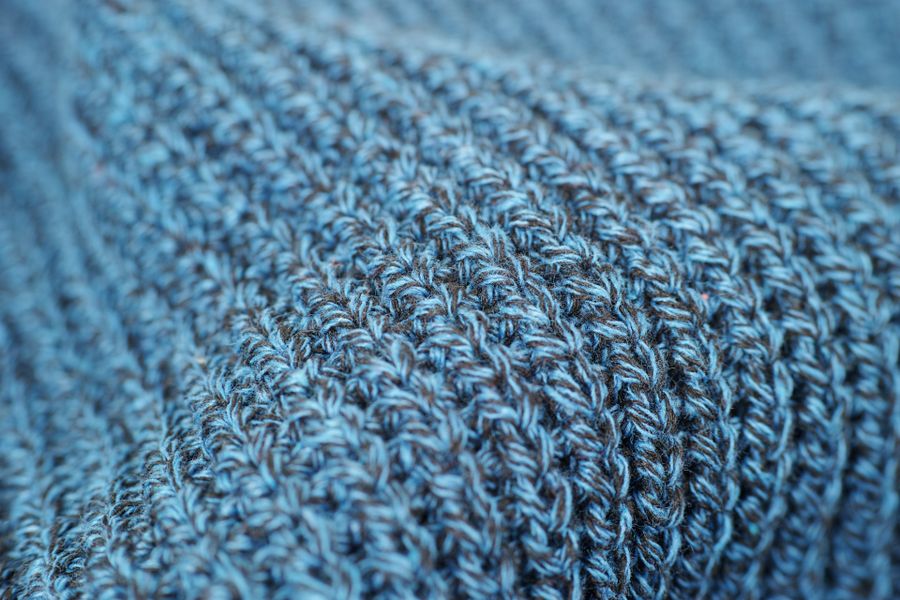
Two processes, one raw material
Raw wool arrives as a mass of fibres of varying lengths, pointing in every direction. Everything about the finished cloth depends on what happens next, and there are two established routes with quite different aims.
The worsted route combs the wool, which pulls the fibres parallel and removes the short ones entirely. What is left is a smooth, aligned bundle of long fibres, which is then drawn out and spun with substantial twist into a fine, dense, even yarn.
The woollen route does the opposite. The wool is carded rather than combed, which opens the fibres and mixes them without aligning them, keeping the short fibres in and leaving everything pointing in various directions. The resulting yarn is spun with less twist, is bulkier for its weight, and traps a great deal of air.
What each yarn gives you in cloth
A worsted cloth is smooth, cool to the touch and comparatively dense. Because the fibres are parallel and highly twisted, the yarn presents a hard, even surface, which resists abrasion, takes a sharp pressed edge and shows the weave structure clearly. Suit cloth is worsted almost by definition.
A woollen cloth is fuzzy, lofty and warm out of proportion to its weight, because all those disordered fibres hold still air and still air is the actual insulator. It drapes softly, blurs its own weave, and forgives irregularity. Tweeds, flannels and most heavy coatings come from this route.
Warmth and formality therefore end up pointing in opposite directions, which is one of the quiet frustrations of dressing for cold weather in formal clothes. The smoothness that reads as formal is exactly the property that reduces trapped air.
Durability behaves differently in each
Worsted cloth wears well against abrasion because the surface is hard and there is little loose fibre to be rubbed away. Its characteristic failure is shine: repeated friction at elbows, seat and cuffs flattens the yarn surface and it starts reflecting light directly, which is effectively polished cloth rather than worn-through cloth.
Woollen cloth resists shine almost entirely, since the surface is a mass of fibre ends that cannot be polished. What it does instead is pill and shed, because those short loose fibres work free readily. It also felts more easily, as the disordered fibres have more freedom to migrate and lock together under agitation.
Neither is more durable in general terms. They fail in different ways, and which failure you mind more is a reasonable basis for choosing between them.
Pressing, creasing and shape
A worsted trouser holds a crease because the aligned fibres in a tightly twisted yarn can be set into a shape by heat and moisture and will hold it, and because the dense structure gives the crease a clean fold to sit in. The same properties let a tailor press shape into a jacket chest.
Woollen cloth resists sharp pressing and always will. The surface is too irregular to give a knife edge and the loft is precisely what pressing destroys. Flatten a flannel too hard and you lose the character you bought it for, which is why heavier woollens are pressed lightly with steam and a cloth between.
Recovery from creasing runs the other way. Woollen cloths shrug off wrinkles as the fibre crimp pushes the structure back open, and a soft tweed will hang out a day of sitting. A fine worsted holds the crease you put in it, wanted or not.
Where the two meet in practice
Many real cloths sit between the poles. Semi-worsted processes and blended constructions exist, and a cloth can be woven from worsted yarn in one direction and woollen in the other. Milling and finishing complicate it further, since a worsted cloth can be given a raised surface after weaving that makes it look woollen.
The practical reading is by hand rather than by label. Rub the surface. If it is smooth, cool and reveals a clear weave, you are holding a worsted. If it is warm, slightly hairy and the weave is obscured, it came off a carding machine.
That single distinction predicts a surprising amount: how the garment will drape, whether it will hold a crease, how it should be pressed, whether it will pill or shine, and how warm it will be at a given weight. It is more informative than most of what is printed on the ticket.
Common questions
Is worsted cloth better quality than woollen?
No, though it is often more expensive, because combing removes a large share of the fleece and long fibres cost more. They are different products for different purposes. A fine worsted is the wrong cloth for a winter coat and a heavy woollen is the wrong cloth for a summer suit.
Why does my suit have shiny patches at the elbows?
The surface of the worsted yarn has been flattened by repeated rubbing, so it now reflects light rather than scattering it. Steam and gentle brushing can lift the fibres slightly and reduce the effect, but the change is largely permanent. Rotating suits and pressing gently rather than hard slows it down.
Does the same distinction apply to knitwear?
It does, and it explains a great deal about jumpers. Worsted-spun knitting yarn gives a smooth, defined, hard-wearing stitch that resists pilling. Woollen-spun yarn gives a soft, lofty, warmer fabric that pills more readily. Neither is a defect; they are two choices with different consequences.
Tara has written about fit, fabric, care & repair for most of the last decade and prefers a plain explanation to a clever one.