
Fit
A size range is one pattern stretched, and the stretching has rules
Every size in a range comes from a single master pattern scaled up and down by fixed increments, which explains why garments fit best in the middle of a range and worst at the ends.
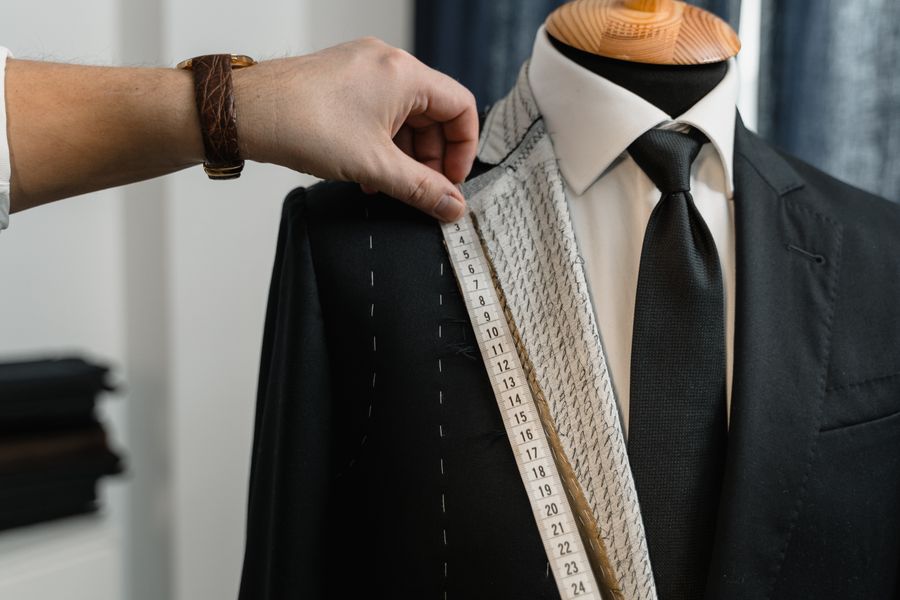
One pattern, many sizes
Clothing is not designed size by size. A designer or patternmaker develops one base size, fits it, corrects it and signs it off, and every other size in the range is produced from that single pattern by a process called grading. Grading applies a set of increments to defined points on the pattern outline, pushing each point outwards or inwards by a specified amount.
Those increments are not invented per garment. A workroom will have grade rules — a table stating how much each point moves per size step — and they are applied consistently across a range, sometimes across an entire company. It is closer to bookkeeping than to design.
This is a good system for making thousands of garments cheaply, and it has one structural weakness that no amount of care removes. The base size is the only one that was ever fitted on a body.
Bodies do not scale the way patterns do
If people simply got proportionally larger, grading would be trivial: enlarge everything by the same percentage and the fit would hold. But bodies vary in circumference far more than they vary in the vertical measurements that go with it. Two people whose chests differ by fifteen centimetres may have almost identical shoulder-to-waist lengths.
Grade rules try to account for this by moving different points by different amounts. Width points move a lot, length points move a little, and armhole depth moves somewhere in between. Those ratios are estimates drawn from body measurement data and from workroom experience, and they describe an average relationship rather than any individual.
The result is a range that fits an average shape at every size and a specific person at, at best, one of them. Nothing is being done badly here. It is a limitation baked into making clothes before you know who will wear them.
Why the ends of a range fit worst
Grading error accumulates with distance from the base. Three sizes away from the fitted sample, every point on the pattern has been moved three times by an estimated increment, and small inaccuracies in the ratios compound into visible ones.
This is why the smallest and largest sizes in a wide range so often draw complaints. The largest sizes tend to arrive too long in the body and too shallow in the armhole, because length and depth were graded by fixed steps that did not keep pace with circumference. The smallest can end up with armholes too big and shoulders too wide for the chest they belong to.
Ranges built around more than one base pattern avoid a lot of this, and some makers do exactly that, fitting a second sample partway up the range and grading outwards from both. It costs more. You can sometimes feel the difference without being told about it.
The fit sample is a real person and it matters who
The base size is fitted on a live body, and that body has a particular height, posture and set of proportions. Everything downstream inherits them. A range fitted on someone with square shoulders will produce jackets that ripple slightly on sloped ones through every size, because the shoulder angle is not a graded quantity — it just gets copied.
Posture is copied too. A base pattern fitted on someone who stands very upright will fit anyone with a forward head or rounded upper back badly, and the effect shows as a collar standing away at the back of the neck across the whole range.
This is the honest explanation for the common experience of one maker fitting you consistently well and another consistently badly at nominally identical measurements. You are not matching a size. You are matching a body somebody else was fitted on.
What to do with the knowledge
The practical move is to stop shopping by size label and start shopping by garment measurement. Take a garment you own that fits, measure it flat across the chest, the hem, the shoulder and the sleeve, and compare those numbers to whatever the seller publishes. Flat measurements are far more reliable than a size name.
Second, once you find a range whose base size sits close to yours, stay with it. You are near the fitted sample, so grading error is minimal, and repeat purchases will behave predictably.
Third, treat the extremes of any range with more scepticism than the middle, and expect to spend on alterations there. That is not a counsel of despair. It is simply reading the manufacturing process correctly and budgeting for what it cannot deliver.
Common questions
Why do some ranges stop at a certain size rather than continuing?
Because grading beyond a point produces garments that no longer fit properly, and continuing the range honestly requires a second fitted base pattern and a second set of grade rules. That is real development cost. Ranges that extend a long way from one base pattern are usually the ones drawing complaints at the far end.
Is vanity sizing the same thing as grading?
No. Grading is the geometry of scaling one pattern across a range. Vanity sizing is a marketing decision to attach a smaller number to a given set of measurements. They interact, since shifting the labels shifts which graded size you end up buying, but they are separate processes.
Which measurements should I record to shop reliably?
Chest or bust across the flat garment, waist, hem, shoulder point to shoulder point, sleeve from shoulder seam to cuff, and full length from the base of the collar. Take them from a garment you already like rather than from your own body, since garment measurements include the ease the pattern intended.
Tara has written about fit, fabric, care & repair for most of the last decade and prefers a plain explanation to a clever one.