
Fit
Pockets change the line of a garment before they hold anything
A pocket is a bag of cloth attached to a panel that was cut to hang smoothly, and how it is attached decides what it does to the shape around it.
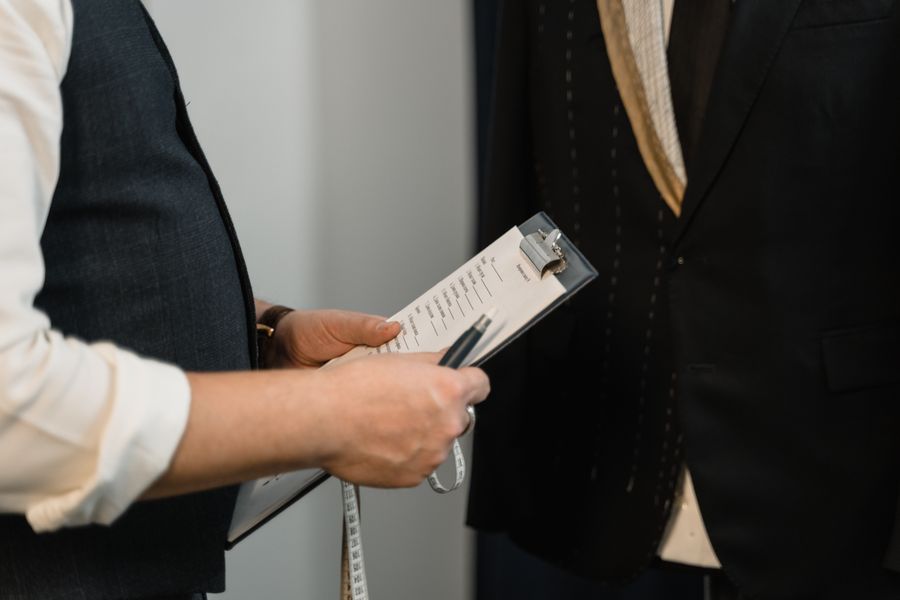
Three ways to attach a bag to a garment
Almost every pocket in a wardrobe belongs to one of three families. A patch pocket is a piece of cloth stitched onto the outside of a panel. A welt or jetted pocket is a slit cut into the panel with a bag hanging inside and finished edges concealing the opening. A seam pocket hides its opening inside an existing seam, usually a side seam.
The three differ in how much they interrupt the surface. A patch pocket sits proud of the cloth and reads immediately as casual, because the construction is visible and the panel underneath is intact. A jetted pocket is a cut through the panel, which is far more delicate work and considerably harder to undo.
Formality tracks that difference closely and not by accident. Visible construction is informal; concealed construction is formal. It is the same principle that puts stitched-down patch pockets on field jackets and near-invisible jetted ones on evening wear.
The bag is where the weight goes
The pocket you see is only the opening. Behind it hangs a bag, usually of lighter cloth, and everything you put in the pocket loads that bag. The bag hangs from the seam or the welt, so all the weight is transferred into a short line of stitching on a panel that was cut to hang smoothly.
This is why loading a jacket pocket distorts the garment so quickly. The weight pulls that section of the front panel downwards, the cloth around it stretches slightly, and after enough repetitions the distortion stops being temporary. The lower front of an old jacket often bulges permanently for exactly this reason.
Bags are also a wear point out of sight. They are made of thinner cloth than the garment, they get abraded by whatever lives in them, and a hole in a bag will quietly deposit your keys inside the lining. Replacing a bag is cheap, quick and worth doing early.
Why new pockets are stitched shut
Jetted and welt pockets on a new jacket often arrive basted closed with loose white thread. That is not packaging carelessness. The garment was pressed with those openings held flat and shut, and keeping them shut protects the shape while the jacket travels, hangs and is tried on repeatedly.
Once opened, a pocket mouth begins to gape a little as the surrounding cloth relaxes, and the jacket loses a small amount of its factory smoothness. There is a reasonable argument for leaving the breast pocket and hip pockets closed on a formal jacket and only opening what you will actually use.
The basting stitch itself should be cut, not pulled, and cut at the surface rather than tugged from one end. Pulling risks dragging the thread through the cloth and leaving a permanent line of small holes along the pocket mouth.
Trouser pockets and the gaping problem
Side pockets on trousers open into a seam that sits directly over the hip, which is the widest point of the lower body and one that changes dimension when you move. If the trouser is even slightly tight across the seat and hip, the easiest place for the strain to escape is the pocket opening, which pulls apart.
Gaping pockets are therefore a fit signal rather than a construction fault, and taking the pocket in does not solve it. The remedy is more room through the seat, if the seam allowance is there, and otherwise a different trouser.
Back pockets bring a separate problem, which is that anything carried in them sits between the body and a chair for hours at a time. That compresses the cloth over the pocket into a permanent outline, and on denim it leaves a faded rectangle that never fully leaves.
The uneven distribution of usable pockets
Pockets are not distributed evenly across garments intended for different wearers, and the gap is well documented in garment measurements. Pockets on many women’s garments are smaller, shallower, or sewn shut permanently as pure decoration, while equivalent men’s garments carry functional ones.
The immediate causes are prosaic. A deep pocket bag adds bulk to a silhouette cut close through the hip, it uses more cloth and more labour, and where a garment is designed around a smooth line, a bag full of objects works directly against it. Decorative pockets are cheaper to make than working ones.
None of that makes the outcome inevitable, and there are plenty of garments cut close that still carry usable pockets. But it does explain why the choice keeps getting made, and it is worth checking with a hand rather than an eye before buying, since a pocket that is only a line of stitching looks identical to one that opens.
Common questions
Should I open the pockets on a new suit jacket?
Open the ones you intend to use and leave the rest. A closed pocket keeps its pressed shape indefinitely, and there is no downside to leaving a breast pocket basted if nothing will ever go in it. Cut the thread at the surface rather than pulling it out.
Can a tailor add a pocket to a garment that has none?
Sometimes, though it means cutting into a finished panel and matching cloth for the welts, which is why the labour is significant. Adding an interior pocket to a lined jacket is much easier than adding an exterior one, since the work happens on the lining and nothing visible is cut.
What actually ruins a jacket pocket?
Weight, carried habitually. A phone in a hip pocket every day loads a short line of stitching on a panel cut to hang free, and the cloth eventually keeps the shape. The breast pocket is worse in one respect, since anything there sits over the chest canvas and distorts the part of the jacket that holds its shape.
Marta covers fit, fabric, care & repair and the questions readers actually send in and is happiest when a piece answers the question completely.