
Fit
Half your clothes are worn sitting down and almost none are fitted that way
A garment is assessed standing still in front of a mirror and then spent most of its life in a chair, where the body it has to accommodate is a different shape entirely.
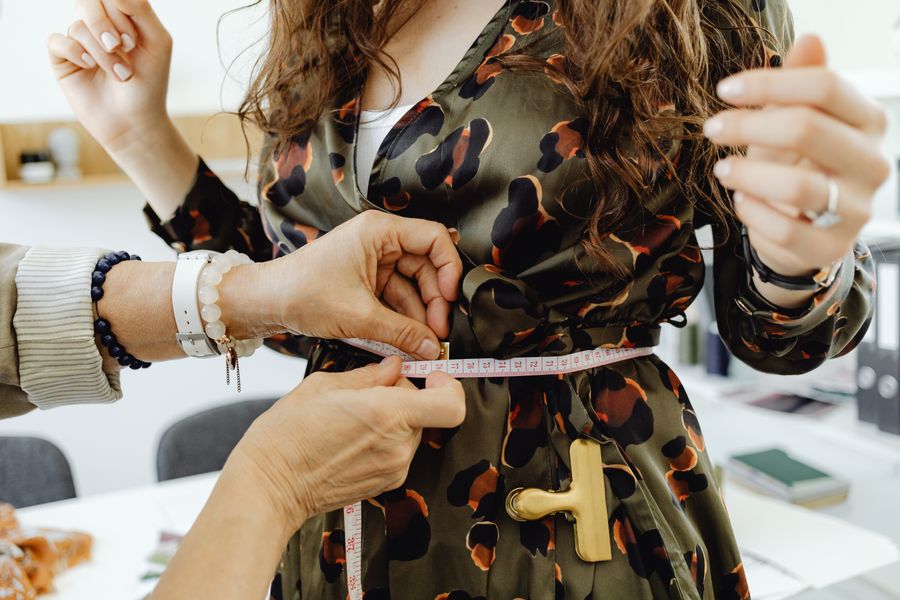
The fitting room is a standing room
Try to remember the last time you sat down while trying something on. Most people never do it. The mirror is arranged for standing, the assistant is waiting, and the whole ritual of assessment is built around a static, upright, front-facing view of a garment.
Then the garment goes to work, and a great many working days are spent seated for hours at a stretch, with a commute at either end that is also frequently seated. The proportion varies with the job, obviously, but for a large number of people the majority of hours a garment is worn are hours in a chair.
Sitting isn’t a small adjustment to the standing shape. The pelvis rotates, the seat and thighs spread against the chair, the distance from waist to knee along the outside of the leg shortens while the distance across the back of the hip increases, and the torso shortens at the front and lengthens at the back. A garment that was cut for the standing version has to absorb all of it.
What sitting does to a trouser
The back rise takes the strain first. Seated, the length required from waistband to crotch around the back increases noticeably, and a trouser without enough there responds by pulling the waistband down at the back, which is the origin of the gap that appears above the belt whenever someone sits.
The thigh is next. Thigh circumference increases when the muscle and soft tissue flatten against a seat, and a close-cut trouser goes taut across the top of the leg. In a cloth with no stretch this is where seams give way over time, and it’s also where the knee bags, because cloth pulled repeatedly over a bent joint deforms.
Jackets, buttons and the seated torso
The convention that a single-breasted jacket is unbuttoned when sitting is often presented as etiquette, and it’s really mechanics. Seated, the front of the torso compresses and the waist expands, so a jacket fastened across it is under considerable tension at exactly the point where the button sits.
Left buttoned, the strain shows as an X of drag lines radiating from the fastening, and over time it distorts the front edge and can pull the buttonhole out of shape. The garment is not designed to be closed in that position, and the etiquette grew up around the fact.
The back of a jacket has its own solution. A vent, whether single or double, exists so that the skirt of the jacket can open rather than stretch when you sit or put a hand in a pocket. A jacket with no vent looks clean standing and is meaningfully less comfortable in a chair, which is the trade being made.
Skirts, dresses and the length that changes
A straight skirt shortens when you sit, because the cloth has to travel up over the fullest part of the thigh, and a length that reads as conservative standing can be considerably shorter seated. Anyone who wears skirts for work knows this already, though it is rarely stated as a fitting principle.
The mechanism is the same as with a trouser and the remedy is different: a shape with more width low down, a longer length, or a fabric with some give and some grip. Dresses add a further complication, since the bodice and skirt are joined at a point that moves relative to the body when you sit, and a very fitted bodice will feel it.
Shirts, tucks and the gap at the back
A tucked shirt untucks itself at the back when the torso bends and the back length required increases. Longer tails exist for this reason and not for any decorative one, which is why dress shirts have long, curved tails and casual shirts cut for wearing loose have short, straight hems.
The other seated shirt problem is the front, where the cloth between buttons is pulled sideways by the compression of the torso, producing the gap that appears at the chest or the waist. It is a width problem, and going up a size fixes it at the cost of everything else. Knitted garments handle the whole business better because they stretch and recover, which is a real advantage rather than mere laziness.
Testing for it takes about fifteen seconds
In the fitting room, sit down on the bench that is almost always there. Sit properly, as you would at a desk, not perched on the edge. Then stand, and reach forward as though for a keyboard or a steering wheel.
What you are looking for is nothing dramatic: whether the waistband stays where it was, whether the thigh goes tight enough to be uncomfortable, whether the shirt pulls out, whether anything digs in at the front of the hip. If the garment is fine standing and unpleasant seated, you have learned the more useful of the two facts.
None of this argues for buying everything loose. It argues for choosing where the ease goes, and for accepting that a garment which looks its absolute best in a mirror and cannot be sat in comfortably has been optimised for a small fraction of the time you will spend in it.
Common questions
Does stretch fabric solve the seated problem?
It helps considerably, since a few percent of elastane lets a close cut accommodate the change in shape without straining seams. It does not solve everything: stretch fibre fatigues over time, and a garment relying on it to cover a genuine shortfall of cloth will bag out at the knees and seat sooner than one cut with the room built in.
Why do my trousers wear out at the seat and thighs first?
Because those are the areas under both pressure and abrasion whenever you are seated, and the cloth there is also under tension. Rotating trousers rather than wearing the same pair daily helps, since fibres recover from deformation given time, and a lining or a heavier cloth in that area delays it further.
Is a jacket vent worth insisting on?
For anything worn seated, it is worth having. Ventless jackets look very clean standing and they concentrate all the strain of sitting into the seat of the garment. Single and double vents both work; the double vent gives slightly more freedom and is generally more forgiving over a fuller seat.
Lukas joined to cover fit, fabric, care & repair and stayed for the awkward questions and reads the small print so you do not have to.