
Fit
Short and long sizes move the horizontal lines, not just the hems
A proper short or tall range is a different pattern rather than a shortened one, because height is not distributed evenly and the places it needs removing are mostly above the knee.
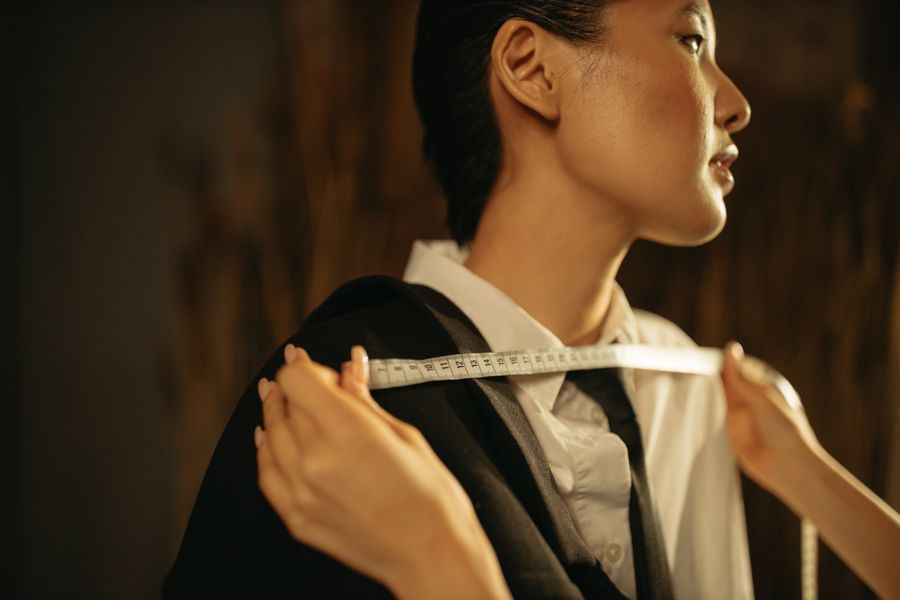
Height is not distributed evenly between people
It would be convenient if two people of different heights were scaled versions of each other, so that a taller person had proportionally longer arms, a proportionally longer torso and proportionally longer legs. Bodies don’t oblige. Two people of the same overall height can differ substantially in how much of it sits above the hip and how much below.
This is why height alone is a poor guide to what will fit. A long-legged, short-bodied build and a long-bodied, short-legged build at the same stature need quite different garments, and the standard range serves neither of them especially well because it’s cut for a proportion somewhere between.
Manufacturers who offer short, regular and long ranges are acknowledging this in a limited way. What matters is whether they have redrafted the pattern or simply moved the hem, and the difference between those two approaches is most of what separates a range that works from one that doesn’t.
The landmarks that have to move
On a jacket the vertical landmarks are the depth of the armhole, the height of the chest pocket, the position of the waist button, the level of the flap pockets and the overall length. Change the height of the wearer and every one of those has to move, because each is anchored to a part of the body rather than to a distance from the hem.
The waist button is the critical one. It should sit at or fractionally below the natural waist, since that is the point around which the whole silhouette is organised, and a button placed too low makes a torso look long and a chest look shallow regardless of how good the rest of the fit is.
On a trouser the equivalent landmarks are the rise, the position of the widest point of the thigh, the knee, and the hem. A properly drafted short trouser removes length from the leg above and below the knee in proportion, so that the knee point still lands on the knee.
What shortening a hem cannot fix
Take a regular jacket and shorten it. The length is now right and the armhole is still cut for a longer torso, so it sits low, the pockets sit low, and the button remains below the natural waist. The garment reads as wrong and it is hard to say why, because the one dimension anyone measures is now correct.
The same applies to trousers, where shortening a leg drafted for a taller wearer leaves the knee point above the actual knee and the widest part of the thigh in the wrong place. In a slim cut this shows as the leg narrowing too early; in a wide one it barely shows at all, which is why looser trousers tolerate crude shortening.
Where the elbow and the armhole draw the line
Sleeve length can be adjusted at the cuff for small amounts and at the shoulder for larger ones. Adjusting at the shoulder is more expensive and more risky, and it is done precisely because it preserves the position of the elbow and of the sleeve buttons.
Armhole depth is effectively fixed. Raising an armhole means recutting the body panels, resetting the sleeve and reworking the lining, which few people will pay for and which cannot go far in any case. A low armhole on a short-torsoed wearer is a permanent condition of the garment.
This is the real argument for buying from a short or long range rather than buying regular and altering. The alterations available to you all work on the bottom edges of things, and the problems created by a wrong vertical proportion mostly live in the middle.
Reading a range before you trust it
The test is straightforward in a shop. Compare a short and a regular of the same size on the rail, and look at whether the pockets, the buttons and the armhole have moved, or only the hem. If only the hem has moved, the range is a convenience rather than a redraft, and it will serve you the way a shortened regular would.
The same check works on trousers by laying one over the other and seeing whether the rise differs. A short trouser with an identical rise to the regular has taken all its length out of the leg, which suits a person with short legs and a normal torso and nobody else. Some ranges are honest about being length-only, and for a buyer whose proportions match the standard pattern that is genuinely enough.
Working out which of your dimensions is unusual
The useful measurement is not height but the ratio between parts. Measure from the base of the neck to the natural waist, and from the natural waist to the floor, and compare the two. Do it again on a friend of similar height and the difference between builds becomes obvious immediately.
Once you know which end of you is long, the shopping problem simplifies. A long torso wants garments with a high armhole and a waist button that sits high, and it will often be better served by a regular length in a larger size than by a short. A long leg wants rise checked first and hems treated as free. None of this is exotic knowledge, and the only reason it feels obscure is that ready-to-wear has no way of asking the question.
Common questions
Is buying a size down a reasonable substitute for a short size?
Sometimes, and it depends on which dimension is short. Going down a size shortens most vertical measurements a little as well as narrowing the garment, so it can work for someone slim who is proportionally short all over. It fails badly for someone who needs the chest of a larger size with the lengths of a smaller one.
Do tall ranges add length in the right places?
The better ones do, adding to the body and the sleeve and moving the armhole and pockets accordingly. Others simply lengthen the hem and the sleeve, which leaves a tall wearer with a high-sitting waist button and a shallow-looking chest. The rail comparison test will tell you which you are looking at.
What about knitwear and casual clothing?
Vertical proportion matters much less there, because unstructured garments have no fixed landmarks that must line up with the body. A sweatshirt has no waist button and no chest pocket to be in the wrong place, so the tolerance is wide and most people can wear a range of lengths comfortably.
Tara has written about fit, fabric, care & repair for most of the last decade and prefers a plain explanation to a clever one.